Knowledge of a material’s reaction to fire allows to foresee its behavior in a fire: how it will start, evolve, and spread. This is particularly important at the early stages of a fire for people to escape from the scene. The legislation considers this by requiring the reaction to fire characteristics of certain building components to be determined. Whether you are a fabricator or a supplier, reaction to fire testing is not only a critical tool to achieve safety, but it is also mandatory to comply with Building and Fire Codes. Verifying that your building materials meet designated flammability requirements also helps you shorten the time to market of your products. This document examines some of the typical reaction to fire tests that are performed to determine whether products meet minimum fire protection performance criteria as set out in a building code or other applicable legislation. In particular, we compare CAN/ULC-S109 and NFPA 701 test methods, which assess the flame resistance and flame propagation characteristics of textiles and films used in or outside public occupancy buildings. The first section of the paper gives an overview of the test methods and their applicability. The differences between Small Flame test and Test Method 1, Large Flame test and Test Method 2 are then described in detail, followed by an outline of sample and specimen conditioning requirements, and accelerated aging procedures. Lastly, information on test results is given.
Background
Fabrics and films have posed considerable fire hazards both in historical times and to the present day. In order to ensure the safety of the public with regard to fire, early efforts were initiated to develop more fire resistant materials. Subsequently, Building and Fire Codes established appropriate performance criteria in order to regulate the relative flame propagation requirements for such materials used in public buildings. Today, as textile and film usage evolves into more complicated designs, advanced materials, and fire retarding treatments, there exists the need to adequately assess the relative ability of a fabric or film to withstand an open flame. The potential fire hazard of a material is, in fact, directly related to its ability to resist ignition from an open flame and/or prevent ignition of adjacent materials. Understanding how textiles and films will perform in a fire is of great significance to protect both life and property, especially at the early stages of a fire when safe evacuation is crucial. Fabricators and suppliers of textile fabrics and films that are used in public buildings are, therefore, required to conduct applicable testing on their products and materials to ensure that they are safe and compliant with standards, regulations and industry requirements. Reaction to fire testing is a valuable tool when assessing the combustibility and ignitability of a material. Not only does it provide a better understanding of a product’s behavior in a fire, but it also helps evaluate the contribution to a developing fire in terms of ease of ignition, evolution of smoke or toxic gases, and heat release rate of the burning material. Testing fabrics and films for their reaction properties is also beneficial as part of customer consideration.
Materials Applicable to Tests
All textile fabrics and films that are used in public buildings are subject to legislation related to fire safety. Most fabrics or films are either integrated into other systems (e.g., furniture upholstery, office dividers, wallcoverings, etc.) where different fire test methods are applicable, or are stand-alone materials (e.g., curtains, window shades, draperies, table linens, textile wall hangings, awnings, tents & tarps, architectural fabrics and structures, canopies, marquees, etc.). Any such material that is stand-alone, that is, is not applied to the building surface or any other type of backing structure, is required to be tested to CAN/ULC-S109 and/or NFPA 701. The test required is most often dependent on the jurisdiction into which the product will be sold.
If a material does form part of the interior finish surfaces (e.g., applied or adhered), then in Canada CAN/ULC-S102 would typically apply, while in the U.S. or the Middle East ASTM E84 (UL 723) would usually apply. For stand-alone fabrics in Canada, CAN/ULC-S109 is required by the National Building Code of Canada (NBCC). In the United States, as well as in many countries in the Middle East, NFPA 701 is cited by many of the respective Codes, including the International Building Code and NFPA 101 Life Safety Code. If the intent is to sell the product in Canada and the U.S. (and/or the Middle East), then both CAN/ULC-S109 and NFPA 701 testing would be required.
What is Involved With The Testing
CAN/ULC-S109 Standard Method for Flame Tests of Flame-Resistant Fabrics and Films comprises a Small Flame test and a Large Flame test. In order for a textile or film to be considered acceptable by the NBCC, it must be subjected to both test procedures and must pass both. NFPA 701 Standard Method of Tests for Flame Propagation of Textiles and Films includes Test Method 1 and Test Method 2. Test Method 2 is similar to the CAN/ULC-S109 Large Flame test, while Test Method 1 is a bench scale test that is now very different from the CAN/ULC-S109 Small Flame test. When tested to NFPA 701, textiles or films are considered acceptable if they meet Test Method 1 or Test Method 2, sometimes both. The type of test chosen is usually dependent on the end-use of the material and the weight of the fabric. It should be noted that prior to 1996, the Small Scale test of NFPA 701 was appreciably similar to the Small Scale test of CAN/ULC-S109. However, after 1996, NFPA 701 was revised to include a different small scale test (Test Method 1) which became known as a better predictor for the flammability behavior of single-layer and multilayer assemblies.
TEST METHOD 1
It applies mainly to single-layer fabrics or materials with an areal density less than or equal to 700 g/m2 (21 oz/yd2). These items include curtains, draperies or other window treatments, multilayer curtains and drapery assemblies that are fastened together (i.e., sewn or adhered), and other such fabrics used in other construction applications that are less than or equal to 700 g/m2 (21 oz/yd2).
TEST METHOD 2
It typically applies to single-layer or multilayer fabrics that are greater than 700 g/m2 (21 oz/yd2), vinyl coated fabric blackout linings, plastic films, fabrics used in tents, awnings, tarps, membrane structures or banners.
Comparing the Tests
CAN/ULC-S109 Small Flame Test and NFPA 701 Test Method 1
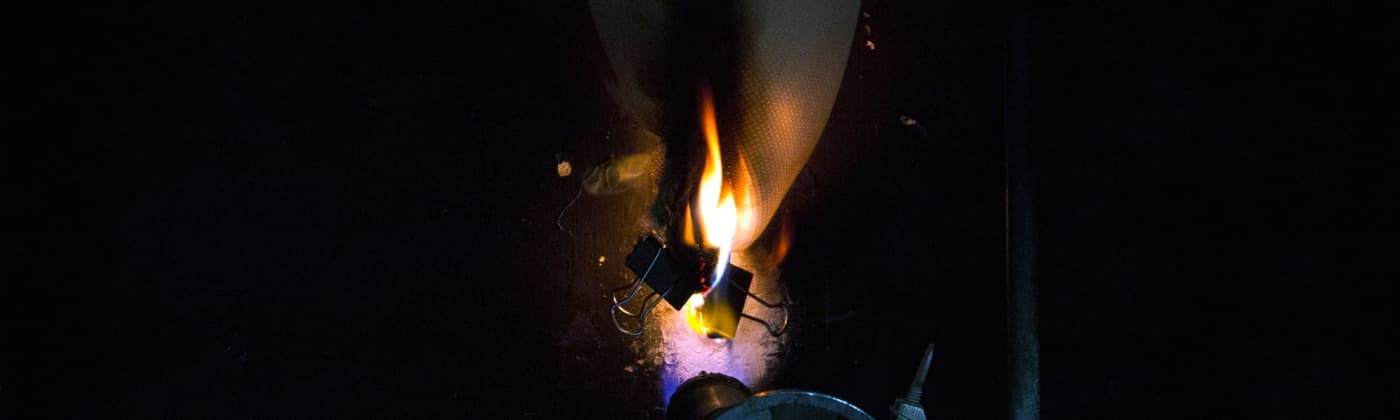
CAN/ULC-S109 Small Flame Test mounts a total of 10 test specimens (5 in each fabric direction), each 90 mm x 250 mm in size, in a metal holder that clamps the edges of the specimens and leaves the ends free. The specimen is then suspended vertically in a sheet metal enclosure so that one end of the fabric extends 20 mm above a 40 mm long, specified Bunsen burner flame. The test burner is mounted at a 25° angle from the vertical and is exposed to the specimen for a period of 12 seconds. Observations are then made to determine the total time of flaming dripping behavior (if applicable), duration of continued surface burning, and length of burn damage after the specimen has extinguished. The material is considered to have passed the test if the maximum average damage length does not exceed 165 mm and the maximum individual specimen damage length does not exceed 190 mm. Flaming dripping behavior cannot continue on the floor of the apparatus for a period greater than 2 seconds. NFPA 701 Test Method 1 requires 10 test specimens, each cut in the long direction of the fabric at 150 mm x 400 mm in size, which are individually weighed to the nearest 0.1g before conditioning. They are then placed in a forced-draft oven at a temperature of 105°C for a period of at least 30 minutes. They are removed one-at-a-time, and are tested within 2 minutes of removal from the oven. Each specimen is attached to a specified pin bar device at the top of the specimen and then the pin bar is mounted such that the hanging specimen is 25 mm from the wall of the test cabinet. Small binder clips are attached to each of the lower corner edges of the fabric in an attempt to stabilize the material. A Meker-type laboratory test burner with a grid top is adjusted to produce a flame length of 100 mm when the burner is in the vertical position. During testing, the burning is tilted 90° from vertical so that the center of the horizontal plane of the burner aligns with the bottom edge of the specimen. The top of the burner is 25 mm away from the face of the specimen in the center of the specimen width. The test flame remains in this position for a period of 45 seconds. Observations are then made to determine the afterflame time and flaming dripping time. The material is then re-weighed to determine weight loss during testing and the percent weight loss is calculated and reported. The material is considered to have passed the test if the average weight loss for the 10 specimens does not exceed 40% and the average flaming dripping time does not exceed 2 seconds. The small scale test methods of CAN/ULC-S109 and NFPA 701 are therefore so different in apparatus, procedure, and principle that data from each test should not be used in any type of comparison with the other.
CAN/ULC-S109 Large Flame Test and NFPA 701 Test Method 2
Both test methods utilize a similar test cabinet apparatus that is approximately 310 mm square, by 2130 mm in height. The main difference is that the CAN/ULC-S109 cabinet utilizes a full-length glass door, which is closed during testing, while the NFPA cabinet exposes the specimens with an open door (no door). The test Bunsen burner for both tests is the same, as is the angle of the burner (25°) and size of the test flame at (approximately 280 mm or 11 inches). The exposure time is also the same at 120 seconds. In both tests, the material can be tested in folds or single sheets. Four folded specimens (material folded 4 times longitudinally to form accordion-pleated specimens with folds approximately 125 mm apart) are the default specimen configuration. Materials that cannot be folded in such a prescribed manner are to be tested as flat sheets. Ten flat sheet specimen replicates are required to be tested. In CAN/ULC-S109 testing, half of the specimens are required to be cut in the long direction of the fabric (warp direction) and the other half tested in the cross direction of the fabric (weft direction). For NFPA 701 testing, all specimens are cut in the long direction only of the fabric. In both tests, preconditioning in an air-circulating oven is required. For both tests, the specimens are clamped and suspended vertically above the test flame, with some side clamps also employed to loosely secure the specimen edges. The test flame is positioned under the specimen for a period of 120 seconds and then withdrawn. Observations are then made to determine the afterflame time, flaming dripping time, and damaged length. For CAN/ULC-S109 testing, portions or residues that break or drip from the material cannot continue to burn on the floor for a period longer than 2 seconds. For folded specimens, damage cannot exceed 635 mm above the tip of the test flame. For flat, single-sheet specimens, damage cannot exceed 250 mm above the tip of the test flame. For NFPA 701 Test Method 2, afterflame cannot exceed 2 seconds and portions or residues that fall from the specimen cannot continue to burn on the floor of the apparatus for a period greater than 2 seconds. For folded specimens, the length of char cannot exceed 1050 mm and for single sheet, flat specimens, the length of char cannot exceed 435 mm.
Specimen Conditioning Requirements And Accelerated Aging Processes
One of the requisite factors of the respective test standards that is often overlooked or misunderstood is the requirement for pre-test conditioning of the test specimens. This is of particular importance if the use of chemical treatments is needed in order to achieve the required level of flame resistance. For both CAN/ULC-S109 and NFPA 701 testing, it is acknowledged that some fabrics undergo topical fire retardant (FR) treatments in order to satisfy the requirements of testing. Such treatments should maintain their efficacy after exposure to cleaning procedures. Sample and specimen conditioning requirements apply to all test methods listed herein: CAN/ULC-S109 Small and Large Flame Tests, NFPA 701 Test Method 1 and Test Method 2. In addition, materials that could degrade through exposure to outdoor conditions are required to be exposed to accelerated aging procedures. For CAN/ULC-S109 testing, if the material is considered to be used for indoor purposes only (no exposure to active weather), then the material should be subjected to 10 cycles of the specific type of cleaning recommended by the manufacturer.
If laundering or dry cleaning is specified, then the following applies:
Laundering
The fabric shall be subjected to commercial laundering in accordance with CAN/CGSB-4.2 No. 24. Drying in a drying tumbler at a temperature of 57 to 66°C follows. 10 cycles of both washing and drying are to be completed before testing. DRY CLEANING 10/15-minute cycles of dry cleaning are to be completed using specific dry cleaning procedures (as are commonly used by commercial dry cleaners).
Dry Cleaning
10/15-minute cycles of dry cleaning are to be completed using specific dry cleaning procedures (as are commonly used by commercial dry cleaners).
For NFPA 701 testing, when durability to cleaning or weathering is claimed by the manufacturer, the material is to be tested before and after each of the following specific exposure conditions that are applicable to the intended use:
Accelerated Dry Cleaning
3 full cycles of either the dry cleaning procedure recommended by the manufacturer or of conventional, commercial dry cleaning using either perchlorethylene or Stoddard solvent.
Accelerated Laundering
5 full cycles of the laundering procedure recommended by the manufacturer or, conventional commercial laundering, or the laundering procedure establish in AATCC Test Method 124.
Accelerated Water Leaching
The specimens are completely immersed in water maintained at specific temperature for a period of 72 hours. Specimens are then removed and allowed to dry in air.
If the material is subjected to the accelerated laundering procedure, then accelerated water leaching is not required.
Test Results
Are the Test Results Between the CAN/ULC-S109 and NFPA 701 Interchangeable?
There are enough differences between the two test methods that it is now unusual that authorities from opposite jurisdictions will accept test results from the other. However, it is known that some Canadian jurisdictions are seemingly as yet unaware of the changes made to the NFPA 701 procedure and may still accept either set of test results. This goes against the requirements of the NBCC where CAN/ULC-S109 results are exclusively cited for Canadian applications. It is therefore important to consider what the appropriate test requirement is for the respective jurisdiction.
What Should You Do with the Test Results?
Once testing is complete, it is important to establish if the material has passed the requirements before and after conditioning or accelerated conditioning. If so, and the material or product is compliant, then it can be marketed and sold in the respective jurisdiction. In most cases, simple traceability of the actual product to the specimens that were tested is all that is required. As with most reaction to fire tests, the test results apply only to the specimens that were tested. That means that those test results should never expire. The key is being able to establish traceability between the material that is being sold and the material that was tested. In some rare cases, a jurisdictional authority may require additional testing on the product to ensure that the test results are “current” to their satisfaction.
Conclusion
How a fire develops in the very early stages is of utmost importance to ensure safe evacuation. Because textiles and films provide a convenient conduit for flame spread, they can be significant contributors to the growth of building fires. Assessing their flammability characteristics is crucial to understand whether a fire is likely to start and how flames will develop.
Carrying out reaction to fire testing of fabric materials and films is extremely useful for companies seeking a better understanding of their products’ behaviour in a fire. Testing ensures your product is safe and fit for purpose.
By testing you can show that you are compliant with industry requirements, as well as Building and Fire codes. This can differentiate your product from the competitors’ and help you gain the market access you desire.
Element is a global provider of testing, inspection and certification services for a diverse range of materials and products in sectors where failure is not an option. Everything we do is designed to deliver one thing for our customers – certainty that the materials and products we test, inspect and certify are safe, quality, compliant and fit for purpose.
References
- CAN/ULC-S109, Third Edition Standard Method for Flame Tests of Flame-Resistant Fabrics and Films, 2014.
- NFPA 701 Standard Methods of Fire Tests for Flame Propagation of Textiles and Films, 2015 Edition.