

Direct Illumination vs. Reverberation: Testing for HIRF Levels
This article explains HIRF (High Intensity Radiated Field) testing for aerospace components, comparing Direct Illumination and Reverberation methods. It highlights the benefits of each approach, key design considerations to avoid test failures, and how Element EMC and RF engineers can support you in meeting regulatory requirements and delivering reliable, high-quality products.
With modern aircraft striving to increase efficiency through weight reduction and other measures, composite materials are becoming more prevalent in their design and manufacture.
However, composites do not provide as high a level of radiated field (RF) protection as traditional metal fuselage; as a result, more and more systems are now required to meet regulatory requirements against High Intensity Radiated Field (HIRF) levels.
There are two main methods for testing HIRF levels: Direct Illumination and Reverberation. Both have their own set of benefits, but which one will be best for your product?
Direct Illumination
Generally considered to be the conventional method of testing against HIRF regulation, direct illumination testing allows us to focus in on specific areas of a component, as well as quickly evaluate smaller Equipment Under Test (EUT). Because this method relies more on concentrated RF energy, failure threshold levels are easier to determine compared to reverberation testing.
Reverberation
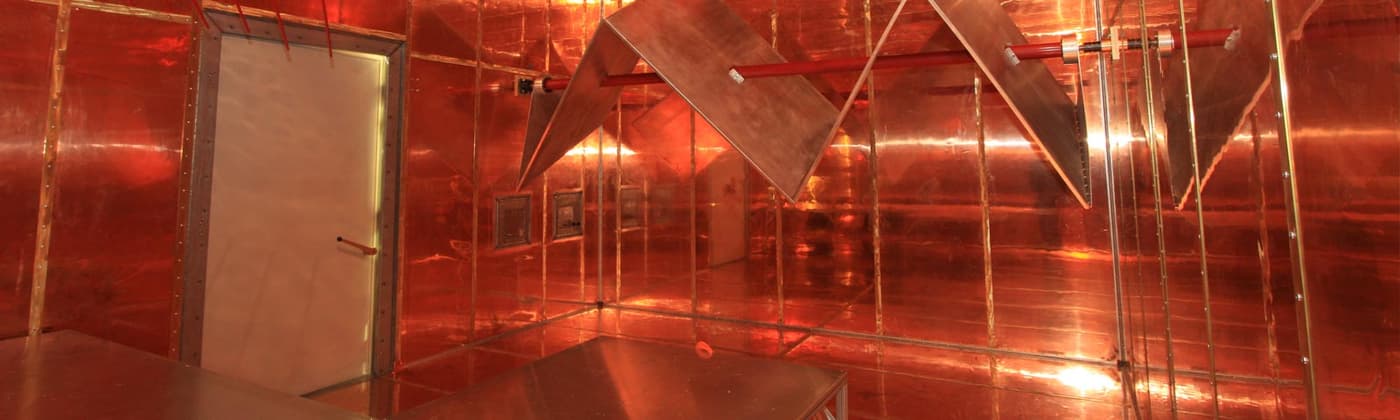
While direct illumination is helpful for smaller EUTs and products with high-risk components, reverberation testing is a quicker method for larger equipment that would be difficult to test with multiple antennas. In addition to illuminating the entire EUT at once and providing a true "worst-case scenario", reverberation testing is able to achieve extremely high field strengths, beyond the capability of direct illumination.
If your customer has not specified a preference, we can offer valuable advice on the best route for your product. However, whether you choose direct illumination or reverberation, some of the most common causes of HIRF test failure can be easily avoided by considering a few key points early in the design stage, such as:
- Ensuring case shielding effectiveness is of sufficient magnitude to reduce incoming RF to a level that can be withstood by sensitive components
- Making sure cables and connectors are well screened and filtered, with 360 degree termination
- Minimizing and avoiding slots (air vents etc.) when possible
- Avoiding conductive loop
Our EMC and RF engineers can work with you from the initial design stage to support you through the complex nature of qualification testing of aerospace components and ensure you deliver against airframe manufacturers’ imposed qualification milestones.
For more information about direct illumination, reverberation and HIRF testing, or for specific questions about your project, contact us today.