

Combined Temperature-Vibration Testing for Batteries: Why Sequential Testing Misses Field Failures
Combined temperature-vibration testing exposes battery failures that sequential single-stress testing misses. In this Element whitepaper, Technical Director Mike Pendleton shows why adding separate thermal and vibration results underpredicts field failure, explains the five mechanisms that compound stresses, and maps the standards, including MIL-STD-810H Method 520.5 and SAE J2380, that require combined exposure.
Who Should Read This Whitepaper on Combined Temperature-Vibration Testing
Written for engineers and program leads responsible for durability and safety qualification of battery cells, modules, and packs. It addresses 4 key questions Mike sees surfacing late in a battery programme:
- A field return points at a joint that neither your thermal nor your vibration test flagged.
- Whether a room-temperature vibration profile is defensible evidence for a product operating from −40 °C to +60 °C.
- Where combined testing is expected under SAE J2380, UN ECE R100, and MIL-STD-810H.
- How to justify a combined rig to an OEM who already accepts single-stress reports.
Why Download This Whitepaper?
- All five mechanisms by which temperature and vibration compound, each with its supporting figure.
- Why the Palmgren–Miner linear damage rule under-predicts damage when stresses act together, and what replaces it.
- The quantified evidence, including measured fatigue-life reductions and natural-frequency shifts.
- The full standards mapping: MIL-STD-810H Method 520.5, IEC 60068, RTCA DO-160, and the battery-specific SAE, UN, and ISO suite.
- Five recommendations for sequencing a battery qualification program, and the limitations of relying on combined testing alone.
To receive a copy of this whitepaper by email, please fill out your details in the form below.
Combined Temperature-Vibration Testing: Abstract
Durability programs have historically applied environmental stresses one at a time, on the unstated and frequently incorrect assumption that the damage from each environment is independent and additive. Fatigue properties, stiffness, damping, and failure modes are all functions of temperature, and thermal-expansion mismatch superimposes a mean stress on the alternating stress of vibration, so the combined damage rate can exceed the sum of the individual rates. This paper sets out the mechanisms, the mathematics, the evidence, and the standards that codify combined testing.
From the Whitepaper: Why the Laboratory Must Match the Service Environment
“The premise of combined testing is simply that the laboratory environment should resemble the service environment. Inside a vehicle battery pack, mechanical vibration and wide temperature excursions occur at the same time, not in neat sequential blocks.”
The Hidden Assumption in Sequential Qualification Testing
A classic flow treats each environment as a discrete block: thermally cycle to one criteria, shake to another, review both side by side. Total damage becomes a linear sum — which assumes fatigue behavior under vibration is the same at +25 °C, −40 °C, and +125 °C, and that thermal-expansion stress is irrelevant while the part is shaken.
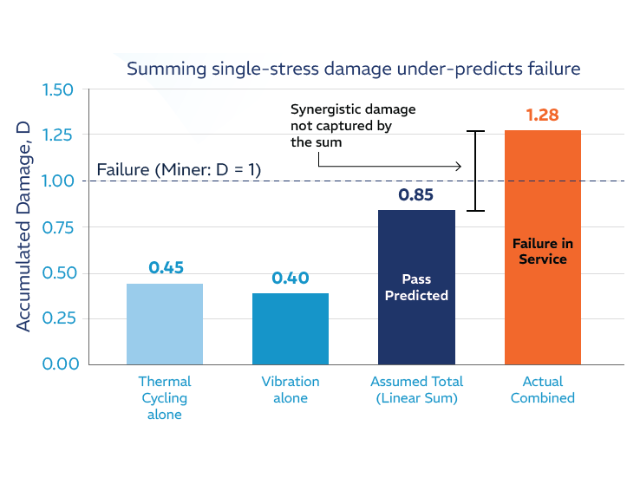
This paper, written by Element’s Battery Technical Director Mike Pendleton, works an illustrative case. Thermal cycling alone accumulates a damage fraction of 0.45; vibration alone reaches 0.40. Their sum, 0.85, sits below the Miner threshold of 1.0, so the program predicts a pass. True combined exposure reaches 1.28 — everything above 0.85 is synergistic damage sequential testing cannot see.
How Temperature and Vibration Compound: The Physics of Synergy
Mike identifies five interacting mechanisms. Three are summarized here; creep–fatigue interaction and thermal aging are covered within the complete whitepaper download.
Temperature-dependent material properties
Elastic modulus, damping, yield strength, and creep behavior shift substantially with temperature, most sharply in solders, polymers, adhesives, and potting compounds. Rising temperatures soften them, so the same input produces larger strains; falling temperatures embrittle many of them. Fatigue resistance measured at ambient does not represent the extremes the product sees.
Resonance shift: When Heat Moves the Natural Frequency Onto the Excitation
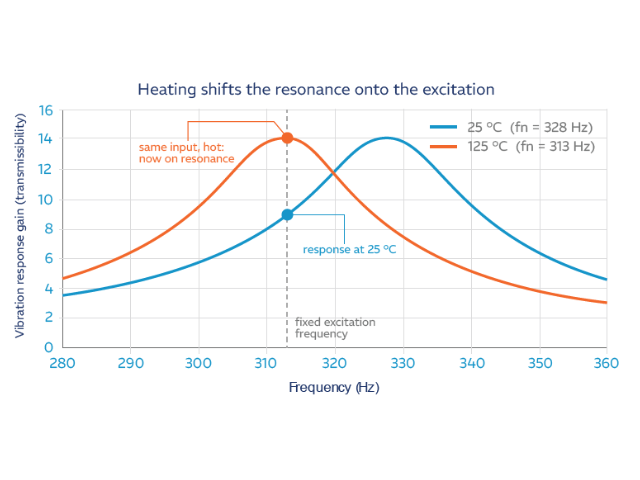
Because stiffness is temperature-dependent, so are natural frequencies. In one controlled study of a populated printed circuit board, the first natural frequency dropped from 328 Hz to 313 Hz as the board was heated from 25 °C to 125 °C. An excitation sitting off-resonance safely at ambient can land directly on a migrated mode once the assembly is hot, which a room-temperature test cannot detect.
Thermal-expansion mismatch as a mean stress
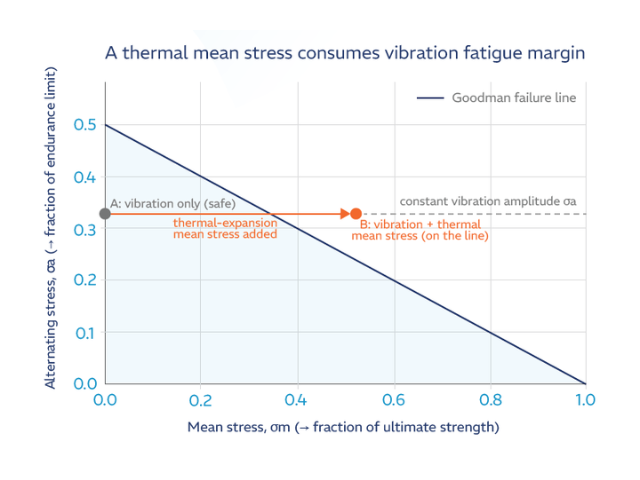
Wherever dissimilar materials are joined — a busbar welded to a cell terminal, a potted module, a soldered component — differences in coefficient of thermal expansion generate internal stress as soon as temperature leaves the stress-free assembly condition. Vibration testing then superimposes an alternating stress on that mean stress. Under a Goodman or Soderberg relationship, tensile mean stress reduces the allowable alternating amplitude for a given life, so an amplitude harmless at zero mean stress becomes damaging.
Why Adding Damage From Separate Tests Under-Predicts Failure
The standard tool for cumulative fatigue damage is the Palmgren–Miner linear damage rule, which sums applied cycles against cycles-to-failure and predicts failure at unity. It is the implicit basis of add-the-damage-from-each-test thinking, and it is linear and history-independent — no term for the S–N curve shifting with temperature, none for thermal mean stress, none for creep.
The temptation is to apply a correction factor, but the literature closes that door. At least one isothermal solder-fatigue study found vibration durability at 25 °C to be lower than at either −55 °C or +125 °C, indicating a non-monotonic dependence. If the direction cannot be predicted, it cannot be extrapolated. The paper sets out the temperature-dependent models that replace Miner's.
What Battery Programs Get Wrong About Environmental Qualification
“Two clean reports and a bit of addition feel like evidence, but they aren't. When you cycle a pack thermally and then shake it, you've characterized two things that never happen separately once the product is in service. The numbers add up to a pass, the pack ships, and the joint that fails in the field is the one neither test was ever able to load properly.”
— Mike Pendleton, Technical Director – Battery, Element
Which Standards Require Combined Environmental Testing?
Combined environmental testing is codified, and in the battery sector already mainstream.
MIL-STD-810H, Method 520.5
The canonical reference. MIL-STD-810 Method 520.5 exists to determine the synergistic effects of combined temperature, altitude, humidity, electrical power, and vibration, and states plainly that those effects may induce failures which would not appear during individual-environment testing. Two cautions matter as much: it is not a substitute for the individual methods unless tailored and authorized, and the profile must derive from the product's real Life Cycle Environmental Profile.
Battery and energy-storage standards
Vibration durability of EV modules and packs is specified by SAE J2380, with system-level requirements in UN ECE R100 and R136, transport safety in UN 38.3, and profiles historically drawn from ISO 12405 alongside cell-level methods in IEC 62660. Laboratories run the three-axis sequence with temperature superimposed throughout, monitoring for loss of continuity and capacity or impedance degradation. Two details separate battery work from general electronics: state of charge materially affects the outcome, and containment must anticipate a thermal event. A thermally stressed cell under mechanical load can reach a venting or thermal runaway condition that neither isolated test would trigger, so the criteria are durability and safety together. IEC 60068, RTCA DO-160, and the HALT/HASS position are mapped in the download.
By Engaged Expert

Related Industries
Battery Environmental and Dynamics Testing from Element
Element's battery testing laboratories combine vibration testing and climatic and environmental simulation with the instrumentation and containment battery work requires. Where failures occur, our battery failure analysis team identifies the root cause.
Combined Temperature-Vibration Testing: Frequently Asked Questions
Does combined testing replace my existing thermal and vibration tests?
No. MIL-STD-810H Method 520.5 is explicit that it is not a substitute for the individual methods unless tailored and authorized. Run single-environment testing first for risk reduction, then combined testing to expose the interactions.
Why can't I apply a correction factor to my room-temperature vibration data?
Because the temperature dependence is not monotonic. At least one isothermal solder-fatigue study found durability at 25 °C worse than at either extreme, and a correction factor requires knowing the direction of the effect in advance.
Is combined temperature-vibration testing required for EV batteries?
There is no single mandate that names it, but SAE J2380, UN ECE R100 and R136, and UN 38.3 shape the vibration and safety requirements, and battery laboratories run vibration with temperature superimposed as standard practice. Treat combined exposure as the expected way to qualify a pack for real service, not an optional extra.
Which standards cover combined temperature-vibration testing?
MIL-STD-810H Method 520.5 is the canonical combined-environments reference. IEC 60068, including 60068-2-53, is the international counterpart, and RTCA DO-160 governs airborne equipment. For batteries, SAE J2380 sets the vibration profile, with ISO 12405 and IEC 62660 supplying test profiles and cell-level methods.
Does state of charge affect combined battery vibration testing?
Yes. State of charge materially affects the outcome, and a thermally stressed cell under mechanical load can reach a venting or thermal runaway condition. Because of this, combined battery testing evaluates durability and safety together, with live electrical and thermal monitoring throughout the run.
Key Takeaways: Test the Combination, Not Just the Components
- Two clean single-stress reports measure conditions the product never meets in isolation, so their sum is not evidence of combined survival.
- Five mechanisms make the stresses compound: temperature-dependent properties, resonance shift, thermal mean stress, creep-fatigue interaction, and thermal aging.
- The Palmgren–Miner linear sum has no term for temperature-shifted S–N curves, thermal mean stress, or creep, so it under-predicts combined damage.
- The temperature dependence is non-monotonic, which rules out a correction factor and means you must test at the service condition.
- Standards already anticipate this: MIL-STD-810H Method 520.5 for combined environments, and SAE J2380 with the UN and ISO suite for batteries.
To receive a copy of this whitepaper by email, please fill out your details in the form below.
Related Services
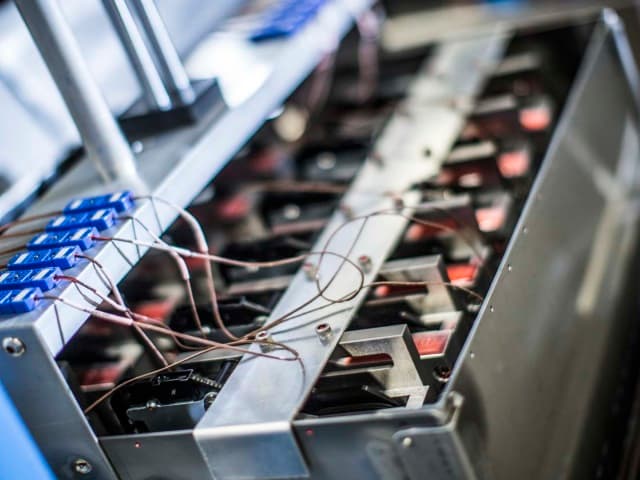
Battery Testing Services
Accelerate your product launch with Element's battery testing services. Superior safety, compliance, and performance data, custom protocols & real-time results. Learn More.
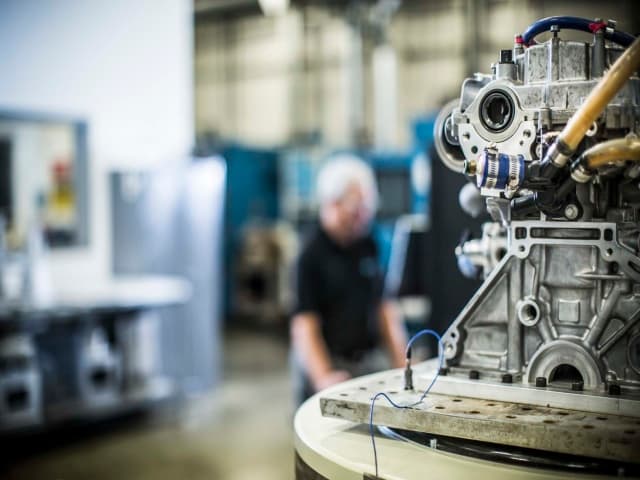
Vibration Testing Services
Ensure your product's safety and durability. Element's advanced vibration testing services replicate real-world scenarios, revealing potential issues before they occur. Learn More.
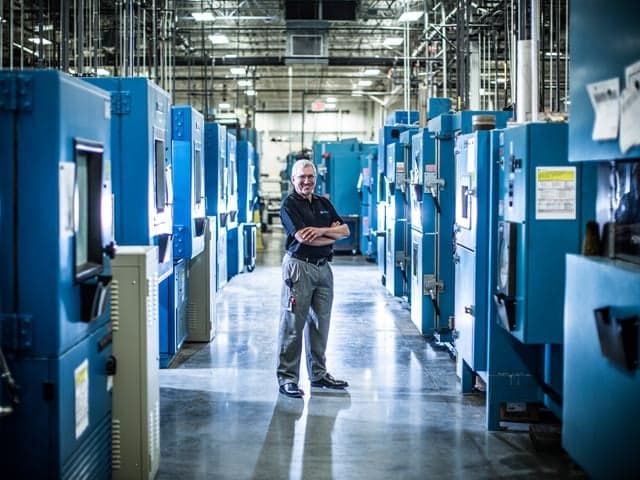
Climatic & Environmental Chamber Testing Services
Test your products' durability with environmental chambers at Element. Accurately simulate real-world conditions to meet industry standards and ensure performance.
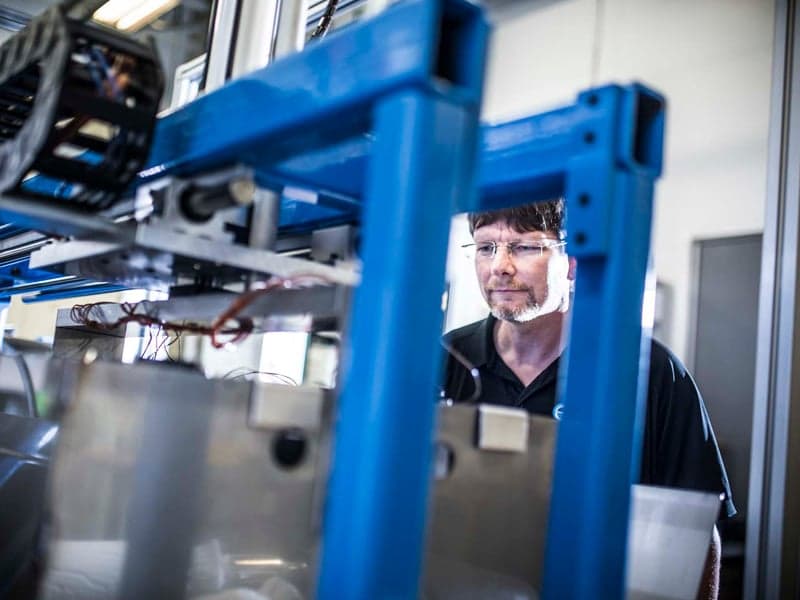
Automotive Battery Testing
Element provides expert automotive battery testing to meet global safety and compliance standards. We test Li-ion and Ni-MH batteries for durability, performance, and regulatory approval.
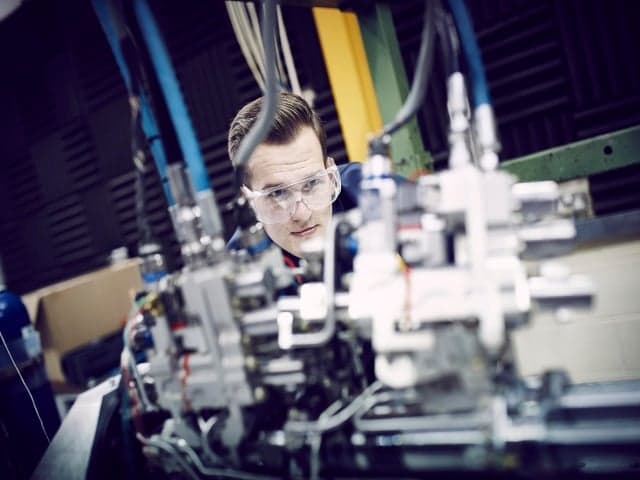
MIL-STD-810 Testing Services
Element's MIL-STD-810 testing services validate military and defense products under extreme conditions, delivering reliable, accredited results for compliance and performance qualification.