

When to Use a Reverberation Chamber for EMI/EMC Qualification
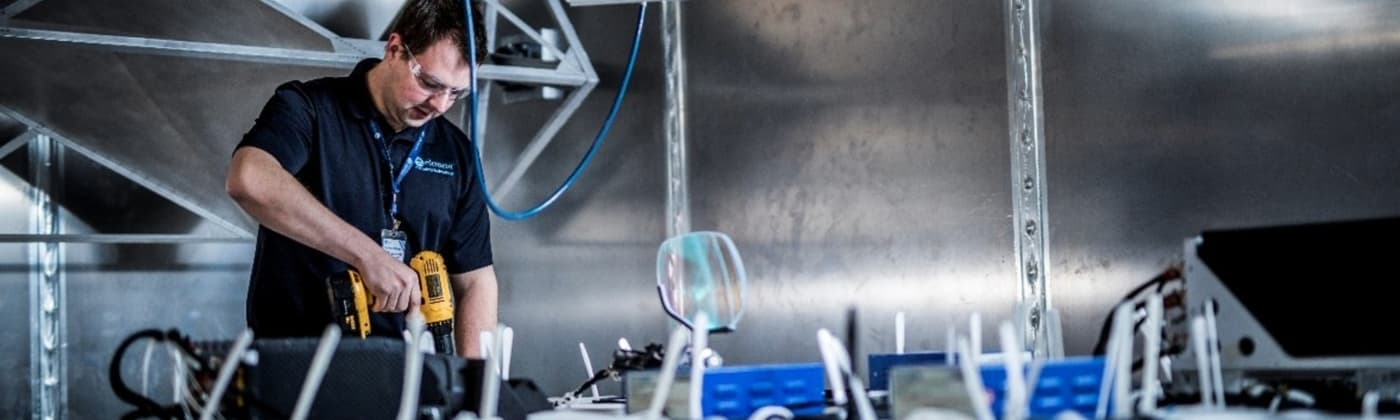
This whitepaper, examines reverberation chamber testing as a proven method for EMI/EMC product qualification. Drawing on standards including RTCA DO-160, MIL-STD-461, and IEC 61000-4-21, it explains how the technique benefits aerospace, defense, automotive, and electronics manufacturers seeking repeatable, cost-effective compliance testing across expanding regulatory requirements.
As electronic systems become increasingly complex and interconnected, ensuring electromagnetic compatibility (EMC) and resilience to electromagnetic interference (EMI) has become a critical component of product qualification. Aerospace, defense, automotive, industrial, and commercial electronics manufacturers must demonstrate that their products can operate reliably in environments saturated with radio frequency (RF) energy while also limiting emissions that could interfere with other systems.
One of the most effective tools for evaluating electromagnetic immunity and emissions performance is the reverberation chamber. Reverberation chamber testing has evolved from a specialized research technique into a widely accepted methodology incorporated into major standards, including RTCA DO-160 and MIL-STD-461. Unlike traditional semi-anechoic chamber testing, reverberation chambers create statistically uniform electromagnetic fields through multiple reflections, offering highly repeatable and efficient testing for a wide range of products.
This whitepaper explores the principles of reverberation testing, its advantages over conventional methods, the standards governing its use, and the applications in which it provides the greatest value for product qualification.
What Is Reverberation Chamber Testing in EMI/EMC?
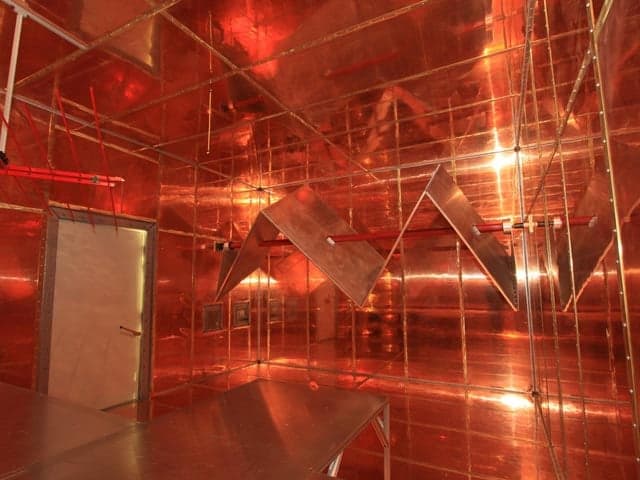
A reverberation chamber is a highly reflective metallic enclosure designed to create a statistically uniform electromagnetic environment. RF energy is introduced into the chamber through transmitting antennas, where it repeatedly reflects off conductive walls, ceilings, and floors. These reflections generate a dense field of standing waves throughout the chamber.
To create field uniformity, a metallic tuner, or mode stirrer, is continuously rotated or stepped through discrete positions. As the tuner moves, it changes the boundary conditions inside the chamber, causing electromagnetic peaks and nulls to shift throughout the test volume. Over time, the equipment under test (EUT) experiences RF energy arriving from all directions and polarizations.
The principle is similar to a microwave oven: in both cases, RF energy reflects within a conductive cavity. However, reverberation chambers are engineered specifically for EMC testing and employ calibrated antennas, field probes, and tuners to ensure a controlled, measurable electromagnetic environment.
Before testing begins, the chamber undergoes a field uniformity calibration process. Multiple probe positions and orientations are measured across the test volume to verify compliance with statistical field uniformity requirements. This calibration establishes the relationship between injected RF power and the resulting field strength, allowing precise control of test conditions during qualification testing.
Why Use Reverberation Chamber Testing for EMC Qualification?
Superior Field Uniformity
One of the primary advantages of reverberation chambers is their ability to produce highly uniform electromagnetic fields throughout a large test volume. Traditional direct illumination methods rely on a single antenna generating a field toward the equipment under test, often resulting in reflections, hot spots, and measurement uncertainty. In contrast, reverberation chambers create an environment where RF energy arrives from multiple directions simultaneously. Through mode stirring, the field distribution becomes statistically uniform, reducing dependence on the equipment's orientation and position.
Exceptional Repeatability
Repeatability is a significant challenge in traditional radiated susceptibility testing. Small changes in cable routing, sensor placement, or antenna position can dramatically affect measured field levels and test outcomes. Reverberation chambers provide a much more repeatable environment because field conditions are statistically averaged over numerous tuner positions. Organizations using reverberation chambers frequently report the ability to reproduce failures and field conditions consistently across multiple chambers and facilities.
Higher Field Strength With Lower Power
Because RF energy is confined within a reflective cavity, reverberation chambers can generate very high field strengths with significantly less amplifier power than anechoic chamber methods require. For example, a properly designed chamber can generate more than 100 V/m with only one watt of input power under unloaded conditions. High-level aerospace qualification tests that reach thousands of volts per meter can often be achieved with amplifier systems that are far smaller and less expensive than those required for direct illumination testing.
Improved Test Confidence
During testing, receive antennas remain inside the chamber, continuously monitoring field conditions. This allows engineers to verify that required field levels are achieved throughout the test rather than assuming that calibration values remain valid after the equipment under test is installed.
What Applications Benefit Most From Reverberation Chamber Testing?
Aerospace Qualification
The most common application of reverberation chambers is radiated susceptibility testing for aerospace equipment under RTCA DO-160. Aircraft systems must operate reliably in increasingly RF-dense environments that include radar systems, satellite communications, wireless networks, and high-power transmitters. Reverberation chambers provide an efficient and repeatable method for demonstrating compliance with demanding susceptibility requirements across broad frequency ranges.
Shielding Effectiveness Evaluation
Another important application is evaluating the shielding effectiveness of enclosures, cables, and connectors. Reverberation chambers are particularly well suited for determining how effectively a product prevents RF energy from entering or escaping a protected volume.
Military and Defense Systems
MIL-STD-461 includes reverberation chamber methods for RS103 radiated susceptibility testing. Although the method is not universally adopted, organizations seeking greater repeatability at higher frequencies are increasingly using reverberation chambers for military EMC qualification. Defense applications benefit in particular from the chamber's ability to generate the extreme field strengths required for mission-critical equipment operating in contested electromagnetic environments.
Radiated Emissions Testing
Reverberation chambers can also be used for emissions measurements. Because energy is reflected throughout the chamber, emissions are captured regardless of their direction of propagation. This reduces the risk of missing narrow-beam emissions that might otherwise be overlooked during traditional antenna scanning procedures. As a result, emissions testing becomes more repeatable and less sensitive to small variations in equipment positioning or cable routing.
Antenna Performance Characterization
Although reverberation chambers are not intended for measuring antenna beam patterns, they can be used to evaluate antenna efficiency and other performance metrics. This makes them useful for wireless devices and communication systems where antenna effectiveness is a critical design parameter.
Which Standards Govern Reverberation Chamber Testing?
Several international and industry standards define methodologies for reverberation chamber testing.
RTCA DO-160
RTCA DO-160 is the primary aerospace EMC standard and the most widely used reverberation chamber testing specification. Reverberation chamber methods were first introduced in DO-160D and have continued to evolve through subsequent revisions. The standard includes detailed requirements for chamber calibration, field uniformity verification, loaded chamber calibration, radiated susceptibility testing, and radiated emissions testing. The latest revisions support both mode-tuned and mode-stirred testing techniques. [1]
MIL-STD-461
MIL-STD-461 provides EMC requirements for military equipment. Reverberation chamber methods were introduced in MIL-STD-461E and remain available in current revisions. The standard includes procedures for RS103 radiated susceptibility testing using reverberation chambers. [2]
IEC 61000-4-21
IEC 61000-4-21 establishes reverberation chamber testing methods for commercial and industrial products. It is commonly used for immunity testing and shielding effectiveness measurements. [3]
Additional Industry Specifications
Other standards, including cable shielding effectiveness specifications and defense-industry requirements, also leverage reverberation chamber techniques for their statistical reliability and efficient field-generation capabilities.
What Factors Ensure Reliable Reverberation Chamber Performance?
Successful reverberation chamber testing depends on several critical design and operational factors:
- Chamber Volume: Larger chambers support lower frequencies but require more power.
- Wall Conductivity: Copper-lined chambers provide superior performance compared to aluminum or galvanized steel due to higher conductivity and improved chamber quality factor (Q).
- Field Uniformity Verification: Comprehensive calibration verifies statistical field consistency across the usable test volume.
- Mode Stirring Performance: Adequate tuner motion and stirring ratio ensure proper averaging of electromagnetic fields.
- Loaded Chamber Calibration: The influence of the equipment under test on chamber loading must be measured to determine the actual power required for testing.
Together, these factors ensure that test results remain accurate, repeatable, and compliant with industry standards.
How do you decide between a reverberation and semi-anechoic chamber?
Choose a reverberation chamber when:
- The applicable qualification method permits or specifies reverberation testing.
- The EUT requires statistically uniform, multi-directional RF exposure.
- The test requires high field strengths and efficient use of amplifier power.
- Repeatability across tuner positions and reduced sensitivity to EUT orientation are priorities.
- The work involves radiated immunity, shielding effectiveness, emissions, or antenna-efficiency measurements supported by the applicable method.
Choose a semi-anechoic chamber when:
- The controlling standard or customer specification requires direct illumination.
- The test depends on a defined antenna-to-EUT geometry, polarization, or face-by-face exposure.
- Directional troubleshooting is needed to isolate a vulnerable face, aperture, cable path, or subsystem.
- The EUT or support equipment cannot be configured within the reverberation chamber’s validated working volume or loading limits.
- The required frequency range extends below the reverberation chamber’s validated lowest usable frequency.
“I start with the governing requirement and the test objective, then look at the EUT size, cable layout, frequency range, field level, and chamber loading. Reverb is often the stronger choice when a program needs efficient high-field exposure and statistical uniformity. Anechoic testing remains the better fit when the method requires controlled, directional illumination or when troubleshooting a specific orientation.”
What do customers commonly underestimate?
- Chamber loading: A large or absorptive EUT can change chamber behavior and the RF power needed to achieve the required field.
- Cable routing and support-equipment configuration: These should be defined before test day because late changes can affect coupling paths, monitoring, repeatability, and schedule.
- Lowest usable frequency: Chamber volume and modal behavior can make a reverberation chamber unsuitable below its validated operating range.
- Operating and monitoring plans: The product must be exercised and monitored well enough to detect degradation and reproduce the test configuration.
“The most common avoidable issue is arriving with an incomplete operating and monitoring plan. The chamber can create the required environment, but the qualification result is only as useful as the team’s ability to exercise the product, detect degradation, and reproduce the configuration.”
Anonymized qualification scenario
A defense electronics manufacturer needed to qualify an equipment assembly to an RS103 radiated-susceptibility requirement at a 200 V/m target field. A reverberation chamber was selected because the program required efficient high-field exposure across a configured system with multiple faces and cable paths. The test structure included chamber validation, loaded-chamber characterization, defined tuner positions, continuous EUT functional monitoring, and documented cable and support-equipment configuration.
References
[1] RTCA, DO-160, Environmental Conditions and Test Procedures for Airborne Equipment
Conclusion
Reverberation chamber testing has become an essential tool for modern EMI/EMC product qualification. By generating statistically uniform electromagnetic environments, reverberation chambers provide superior repeatability, efficient high-field generation, and comprehensive exposure to RF energy from all directions.
Their adoption within standards such as RTCA DO-160, MIL-STD-461, and IEC 61000-4-21 demonstrates growing industry confidence in their ability to provide realistic and reliable qualification results. While traditional semi-anechoic chamber testing remains important for many applications, reverberation chambers offer significant advantages for susceptibility testing, emissions measurements, shielding effectiveness evaluations, and antenna performance assessments.
As electronic systems continue to increase in complexity and operate in increasingly challenging electromagnetic environments, reverberation chambers will play an increasingly important role in ensuring product performance, regulatory compliance, and operational reliability.
Learn more about Element
By Engaged Expert

Related Resources

Related Services
Aerospace EMI/EMC Testing
Element's aerospace EMI/EMC testing helps you meet commercial and military standards with tailored test plans, advanced facilities, and expert guidance to tackle compliance challenges and reduce delays.
MIL-STD-461 Testing Services
Access accredited MIL-STD-461 testing with secure ITAR handling at our specialized military EMC testing facilities. Our MIL-STD-461G testing validates defense systems up to 70 tons with 200V/m capability.
Aerospace RTCA DO-160 Testing
Element RTCA DO-160 Testing: Single-Source DO-160 Testing Performed In State-Of-The-Art Labs. Schedule Your Test Today.