Managing Risk In Product Testing and Regulatory Approvals Webinar

Trying to mitigate risk in your devices regulatory approvals? An important consideration for manufacturers to make is that compliance testing is not just about following a checklist, but about making informed choices to ensure the tested product truly represents real-world use. Standards define the methods and the limits, but they cannot describe every configuration of your product. That decision remains yours, and the difference between a defensible test report and an expensive one is whether you made them from evidence or from assumption.
In this on-demand webinar, Element’s Technical Director Michael Derby covers how to plan for and manage risk in testing and regulatory approvals, how a risk assessment should shape a test plan rather than justify it afterwards, as well as some of the common mistakes manufacturers make and how to avoid them.
Why watch this managing risk in product approvals webinar?
This is not an introduction to compliance testing. It is a session for manufacturers looking to understand more about different types of risk in testing and approvals, and who need to mitigate risk in their product’s compliance programme. After watching, you will be able to:
- Understand the differences and risks between a calculated risk from an unknown one.
- Identify a worst case rather than nominate one.
- Understand how to identify, analyze, act, monitor and control risks within a testing and regulatory approvals programme.
- Learn why firmware test modes, control interfaces and a configuration matrix change what a laboratory can do for you.
- Understand the common mistakes manufacturers make with risk management in regulatory approvals and how to avoid them.
Key topics covered in this webinar
- What is “risk” in testing and regulatory approvals?
- What separates a calculated compliance risk from an unknown one?
- How do you establish which operating mode or channel is worst case?
- How do cables, ports and accessories change the configuration you should be testing?
- Why do firmware modes matter to an EMC result?
- What changes when transmitters can operate simultaneously?
- What risks do radio modules introduce to radio approvals?
- When can evidence be reused across a product family or after a change?
Watch the webinar below
By Engaged Experts

Michael Derby is a Technical Director with more than 35 years in product development and approvals. He supports manufacturers on radio equipment testing, certification and authorization.
Related Industries
Webinar Chapters
Total runtime is about 47 minutes. Use the timestamps to jump to a topic in the recording below.
- 0:00 – Introduction and agenda
- 02:00 – What is risk?
- 05:11 – Risk in compliance
- 07:43 – Managing risk in testing
- 27:14 – What other risks are there?
- 29:52 – Risks associated using radio modules
- 32:06 – Different approaches manufacturers can take
- 34:14 – Types of calculated and unknown risks
- 36:57 – Why do these tests?
- 43:12 – Common mistakes and how to reduce risk
How to manage risk in product testing and approvals
Compliance can look like a low-risk activity, because laboratories measure products against established standards. What the standards cannot do is describe every configuration and use case of every product, which leaves a set of decisions with the manufacturer: which channels to test, which operating modes carry the highest risk, what temperature range reflects intended use, which cables and accessories to connect, which sample represents the family, and how simultaneous transmitters should behave during measurement.
Those choices determine what the evidence actually proves. A product can pass in one mode and produce higher emissions in another. Testing the configuration that happened to be available does not establish that the marketed product resembles the tested one.
Calculated Risk Vs Unknown Risk in compliance testing
Not every reduction in testing creates unacceptable exposure. The distinction Michael draws is whether the decision followed evidence or preceded it.
Calculated risk
A calculated risk is a reduction made after identifying the relevant variables and analyzing their likely effect, with the reasoning retained. Characterizing radio performance across the band before choosing representative channels is a calculated risk. So is using pre-scans to find the mode producing the highest emissions, or comparing variants to establish which is technically worst case. It does not mean compliance is certain in every conceivable condition; it means the uncertainty has been identified and bounded.
Unknown risk
An unknown risk is a reduction made before establishing what could change the result. Guessing which mode is worst case. Assuming the fully populated model produces the highest emissions. Treating a golden sample as representative without comparing it against production units. Omitting modes because there are too many to test. What separates the two is not the number of tests performed, but whether you can explain the decision and produce something to support it.
How to Establish a Worst Case to manage risk
“Worst case” appears in most compliance plans and is more often asserted than demonstrated. The most heavily populated model, or the highest-specification unit, is not automatically the configuration carrying the greatest regulatory risk, and worst case can differ between tests, so a single nominated configuration rarely covers everything.
Operating modes and channels
Transmit power, occupied bandwidth and unwanted emissions can vary across a radio’s band. Where performance is not flat, the center channel may not represent the highest-risk condition, and preliminary measurements will show whether low, middle and high channels are sufficient or whether more are needed.
Cables, ports and accessories
Length, shielding, termination and connector type all affect conducted and radiated emissions. A basic configuration can miss the combination producing the least favourable result, so the plan should account for which ports operate simultaneously and which cables ship with the product.
Firmware and control settings
Different modes change clock activity, data rates, duty cycle and processor loading, so two functionally similar modes can present very different electromagnetic profiles. Manufacturers need to supply the firmware and control interfaces that put the product into stable, reproducible test states; without them, the laboratory cannot exercise the conditions that matter.
Simultaneous transmitters
Assessing Wi-Fi, Bluetooth, cellular and GNSS separately may not represent how the product is sold and used. Whether transmitters can operate together, and what that does to emissions, RF exposure and receiver performance, belongs in the risk assessment rather than in a later surprise.
Risk Assessment as a Planning Tool
The risk assessment should start before formal testing and stay live afterwards, rather than being written up at the end to validate decisions already taken. Michael frames it as five stages:
- Identify the features, modes, radio functions, accessories and markets that could affect compliance
- Analyze which could influence RF safety, emissions, immunity or radio performance
- Act by defining the test scope and representative configurations
- Monitor results, design changes and production variation
- Control by maintaining the documentation and reassessing when something moves
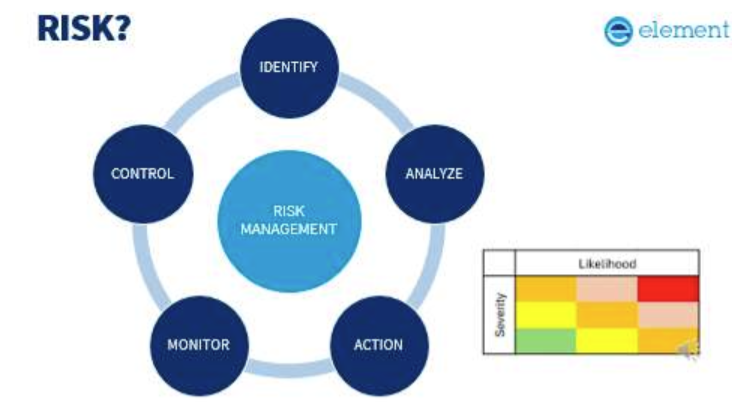
Run in that order, it converts risk management into a documented technical decision and gives the manufacturer and laboratory better information to plan against. Run backwards, it produces a file describing what was convenient rather than what was necessary. The same logic governs what happens with hardware changes after approval, covered in Element’s Changes and Variants webinar, and the specific question of what a module approval does and does not carry into a host product is covered in our Radio Module Integration Guide whitepaper.
Element’s regulatory compliance advisory team help manufacturers mitigate risk early, and can help by review a configuration matrix, identify likely worst-case variants and align test scope with your global market access plan while there are still options. Once a product is in formal testing against a launch date, the safest correction is almost always more testing.
Frequently Asked Question
How do I know which configuration is genuinely worst case?
By measuring rather than nominating. The most populated model, the highest-specification unit or the center channel is not automatically the highest-risk condition, and the worst case can differ from test to test. Pre-scans across modes, channels and cable configurations are what establish it. Depopulated variants deserve particular attention, since a removed component may have been suppressing an emission.
Who decides whether partial testing is sufficient?
The manufacturer placing the product on the market. A laboratory can advise on technical risk and perform an agreed scope, but its report covers only the equipment and configurations actually tested, and it cannot state otherwise. Deriving a compliance conclusion from those results is the manufacturer’s responsibility, which is why the supporting analysis needs to exist in your own documentation rather than in the test report.
Related Services

Wireless Device Testing & Certification
Get your wireless devices to market faster with Element's accredited testing services. Expert guidance through compliance, certification and global approvals for all wireless technologies.

Electromagnetic Compatibility (EMC) Testing & Electromagnetic Interference (EMI) Testing & Certification
Element provides accredited EMC and EMI testing and certification services, helping businesses meet regulatory requirements, reduce costly redesigns, and bring products to market faster through expert compliance support.

Electronic Product Certification and Approvals Services
Accelerate your electronic product certification with Element's ISO 17065-accredited services. Access 167 markets through one trusted partner. Expert testing & compliance support.