

Hearing Aid Compatibility Requirements: What the New FCC and ISED Rules Mean for Wireless Handsets in 2026
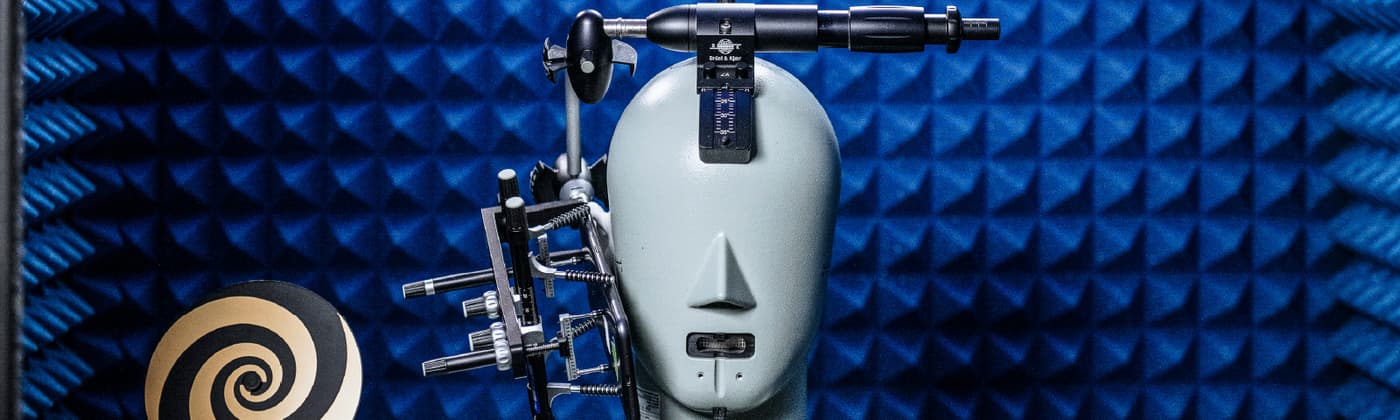
In this whitepaper, Element's Justin Chao (RF Exposure/HAC Technical Director) and Nima Molaei (Senior Global Technical Director) explain the new FCC and Canadian hearing aid compatibility requirements for handset compliance teams, and conclude that HAC must be designed in early, with pretesting and change control, to avoid costly redesigns.
What are the new hearing aid compatibility requirements from December 15, 2026?
The FCC is changing how hearing aid compatibility (HAC) applies to wireless handsets. Previously, manufacturers and service providers could meet HAC requirements by offering a specified percentage of compliant models. Beginning December 15, 2026, every handset model must support acoustic coupling and a second coupling route through telecoil and/or qualifying Bluetooth. Across their portfolio, the manufacturer must have at least 85% of models supporting telecoil and at least 15% supporting Bluetooth coupling. Handset models must also meet the applicable volume-control requirements.[1][2]
For manufacturers, this means hearing aid compatibility requirements need attention well before certification testing. Antenna design, magnetic noise, receiver performance, audio processing and Bluetooth functionality can all affect the final result.
The FCC currently uses ANSI C63.19-2019 for HAC certification. Compared with the 2011 edition, it replaces the M/T rating system with pass/fail criteria, changes how telecoil performance is evaluated across the handset's listening area, and adds volume-control testing by reference to ANSI/TIA-5050-2018. A temporary FCC waiver eases certain volume-control distortion requirements because the published pulsed-noise method can produce misleading failures with modern speech codecs. That waiver runs through September 29, 2027 unless the waiver is extended, or the FCC adopts an effective replacement standard sooner.[1][3]
Canada is also updating its HAC requirements, although the rules are not identical to those in the U.S. ISED's RSS-HAC, Issue 2, currently becomes mandatory for covered radio apparatus on January 1, 2028 unless the deadline is extended. It also references ANSI C63.19-2019 with additional safety limits for volume control. The current Canadian requirement is for 100% compliance of handset models for RF-interference, telecoil and volume-control requirements without alternative Bluetooth compliance methods.[4]
For products launching in 2026 and beyond, the practical approach is to evaluate HAC early in development. Pretesting can identify problems while there is still time to change the design, rather than discovering them just before product launch.
What are the 4 key areas of HAC compliance for wireless handsets?
For someone using a handset, HAC comes down to whether a call is clear, loud enough and free of interference. The way audio reaches the user depends on the handset and hearing device:
- Acoustic coupling places the handset receiver near the ear or the hearing-aid microphone. The handset must limit RF interference that can become audible through sensitive hearing aid electronics.
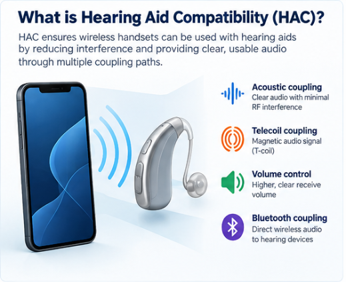
- Telecoil coupling transfers the audio signal magnetically. The handset must produce a sufficiently strong and useable desired magnetic field while controlling unwanted audio-band magnetic noise.
- Volume control supports users who need higher receive volume including those who do not use hearing aids. Higher gain must be delivered without making frequency response, noise, or distortion unacceptable.
- Bluetooth coupling sends audio to a compatible hearing device over a wireless link. Under the FCC rules, merely including Bluetooth is not enough; the coupling implementation must meet the rule’s functionality requirements.
Each area can be affected by a different part of the handset design. Antenna placement can affect the RF field near the earpiece. Display and battery circuitry can alter magnetic noise. A receiver or DSP change can improve gain while reducing audio quality. A software update may introduce a band, codec, or audio path that was never included in the original testing.
A summary of the main risks and corresponding test evidence:
|
User Need |
Principal Risk |
Compliance Evidence |
|
1. Clear acoustic listening |
RF energy couples into hearing aid electronics and becomes audible. |
RF-interference/acoustic-coupling evaluation. |
|
2. Reliable telecoil use |
Weak desired field, poor frequency response, or excessive magnetic noise. |
Desired and undesired audio-band magnetic measurements. |
|
3. Adequate receive volume |
Insufficient gain or degraded speech quality at high settings. |
Conversational gain, frequency response, and distortion/noise results. |
|
4. Direct wireless hearing-aid audio |
Incomplete functionality or limited interoperability. |
FCC Bluetooth coupling and functionality evidence. |
What FCC and ISED hearing aid compatibility requirements must wireless handset manufacturers currently meet?
FCC: United States
US HAC requirements are found in 47 CFR § 20.19. ANSI C63.19-2019, which covers operations from 614 MHz to 6 GHz and references the ANSI/TIA-5050:2018 standard for volume control, has been the exclusive technical standard for FCC HAC certifications since December 5, 2023. The FCC's 2024 Report and Order, FCC 24-112, then established the move to 100% HAC and introduced Bluetooth as an additional coupling mode.[1][5]
ISED: Canada
ISED RSS-HAC, Issue 2, also references the ANSI C63.19-2019 standard for HAC compliance of covered radio apparatuses. The June 2025 amendment moved the mandatory compliance date to January 1, 2028. A HAC test report will become a mandatory requirement as part of the product's Canadian certification application.[4]
Planning for Both the U.S. and Canada
Because both countries reference ANSI C63.19-2019, much of the testing can be performed together to save time and cost. However, there are some differences to note. The United States applies coupling mode percentages to total number of models and allows a qualifying Bluetooth coupling route. The current ISED RSS-HAC requires covered devices to satisfy its RF-interference, telecoil and volume-control provisions; Bluetooth is not a substitute for the Canadian telecoil requirement. RSS-HAC also limits conversational gain at the maximum volume setting to 30 dB and the maximum acoustic level to 100 dB SPL.[4]
What are the critical compliance dates to watch?
|
Date |
Milestone |
Impact |
|
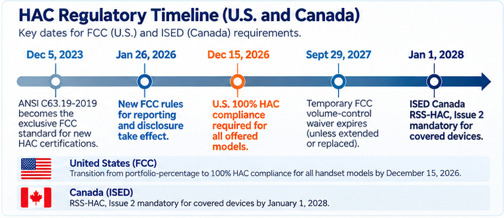
Dec.5, 2023 |
ANSI C63.19-2019 becomes the FCC standard for HAC certifications. |
New FCC HAC filings use the 2019 framework and applicable volume control procedure. |
|
Jan. 26, 2026 |
FCC rules for declaration, disclosure and reporting become effective. |
Revised Bluetooth declaration, labeling, website and reporting provisions take effect.[6] |
|
July 1–31, 2026 |
Final legacy FCC Form 655 manufacturer filing window. |
Filing covers period from July 1, 2025 through June 30, 2026.[2] |
|
Dec. 15, 2026 |
US 100% HAC benchmark begins for manufacturers. |
Every offered model needs acoustic coupling plus telecoil or qualifying Bluetooth; portfolio and new model volume control rules apply. |
|
Jan. 4 - Feb. 1, 2027 |
First revised FCC Form 855 manufacturer filing window. |
Initial report covers December 15-31, 2026; later reports cover full calendar years.[2] |
|
June 15, 2027 |
US 100% HAC benchmark starts for nationwide service providers. |
Nationwide provider portfolios transition. |
|
Sep. 29, 2027 |
Current FCC volume control waiver expires. |
Temporary method ends unless replaced or extended.[3] |
|
Jan. 1, 2028 |
ISED RSS-HAC will become mandatory. |
Covered Canadian radio apparatus must meet RSS-HAC. |
|
June 14, 2028 |
US 100% HAC benchmark begins for non-nationwide service providers. |
Remaining provider portfolios transition. |
|
Dec. 13, 2028 |
FCC non-proprietary Bluetooth benchmark begins. |
Only qualifying non-proprietary Bluetooth coupling counts toward the 15% benchmark. |
What are the primary components of HAC testing to demonstrate compliance?
- RF Interference and Acoustic Coupling
The RF Interference or Emissions evaluation determines whether electromagnetic energy from an operating handset could create audible interference in a nearby hearing aid. Four methods of compliance are provided in the standard, including measurement of peak conducted powers, application of MIF and average powers and measurement of RF emissions. Measurements of RF emissions are made around the acoustic output region under defined transmit and operating conditions. A typical system combines a wireless communications test set, an isotropic electric-field probe, a precision positioning system and appropriate verification sources.
Rather than just a single peak-field measurement, ANSI C63.19-2019 evaluates a 50 mm x 50 mm region centered on the acoustic output, and applies the standard's field and modulation-related criteria to the relevant area. The exact test matrix depends on the supported bands, air interfaces, power conditions and any applicable test reductions.[1][7]
- Telecoil and Audio-Band Magnetic Performance
Telecoil testing separates the wanted magnetic audio signal from unwanted magnetic noise. The desired signal evaluation considers magnetic field strength and frequency response while the undesired signal evaluation characterizes noise generated by handset electronics. The resulting signal-to-noise or signal-quality criteria determine whether the user has a usable coupling region near the earpiece.
The location of the passing area also matters. A handset must show evidence of a qualifying spatial area rather than relying on one passing point measurement. This more closely represents variation in how a user places a handset, but it also means that a local magnetic-noise source can affect more than one result.
Common sources of magnetic noise include display electronics, switching power supplies, high-current paths, clocks, processors, charging circuits, and battery-related components.
- Volume Control
ANSI C63.19-2019 incorporates ANSI/TIA-5050-2018 for receive-volume performance. Testing uses a head-and-torso simulator, controlled handset positioning, standardized signals, and defined handset-to-ear forces. The full published method includes:
- Conversational gain at 2 N and 8 N mounting forces;
- Frequency response against defined criteria; and
- Distortion and noise evaluation at an elevated receive level.
Under the published method, a handset must demonstrate at least 6 dB of conversational gain at 2 N and 18 dB at 8 N, as well as meet the applicable frequency-response and distortion/noise requirements.[8][9]
Temporary FCC Waiver
The pulsed-noise distortion method in the published standard does not provide an accurate evaluation of modern wireless codecs. A study by the ATIS HAC Task Force showed that all handsets in a round robin study would be failing the pulsed-noise distortion test, even though all handsets were compliant under the previous ANSI C63.19-2011 standard. The FCC therefore granted a temporary waiver in 2023, and extended it in August 2025 through September 29, 2027[3][9] to allow time for the TR-41 Standards Committee to develop a new distortion test method for use with modern handsets.
Under the waiver:
- The handset must meet the 6 dB conversational-gain criterion at 2 N across all available narrowband and wideband codec/air-interface combinations;
- An 8 N conversational gain must still be measured and reported, but the 18 dB pass threshold is waived; and
- Frequency response and distortion/noise testing remain with reduced codec and bitrate coverage that includes at least one narrowband and one wideband codec and their associated air interfaces.
The waiver relaxes the distortion test requirements; it does not remove distortion or volume control from HAC compliance. Test plans should identify whether the filing relies on the waiver, and then retain the underlying measurements in case the successor framework changes before certification.
- Bluetooth Coupling
Bluetooth is now included as part of the FCC's hearing aid compatibility requirements, but simply including Bluetooth functionality may not be enough. The implementation must meet the FCC's coupling and functionality requirements, and the compliance record should align with the profiles, pairing behavior, audio routing and user controls offered.[1][5] An attestation letter documenting the Bluetooth implementation is also required with the certification application. From December 14, 2026 to December 13, 2028, proprietary or non-proprietary Bluetooth technology may count toward the manufacturer's 15% benchmark if it meets the proper requirements. From December 13, 2028, only qualifying non-proprietary technology will count. FCC 24-112 identifies Bluetooth LE Audio and the Hearing Access Profile as examples of non-proprietary standards that may support this objective; their presence alone is not an automatic finding of compliance.[5]
What does the FCC's 100% HAC compliance requirement mean for wireless handsets?
There are two parts to the FCC requirement: what each model must support, and what the manufacturer must offer across its product lineup.
Per model: Every handset model in the manufacturer's offered portfolio must support acoustic coupling and at least one second coupling route, either telecoil or qualifying Bluetooth.
Across the portfolio:
- 100% must satisfy the acoustic-coupling requirement;
- At least 85% must satisfy the telecoil requirement, rounded down to a whole model; and
- At least 15% must satisfy the Bluetooth requirement, rounded up to a whole model.
- 100% must satisfy the volume control requirements with any applicable waiver conditions.
A model may support both telecoil and Bluetooth and count toward both percentages. Overlap does not relax the per-model rule: no handset may be left with acoustic coupling alone.[1]
The FCC does retain a grandfathering path for qualifying models certified under an earlier authorized ANSI edition and already offered before the transition. Such models may continue to count through their earlier M3 acoustic or T3 telecoil certification where the rule permits.
However, grandfathering does not allow a non-HAC model to remain in the portfolio, or a new permissive change version, to avoid the 2019 requirements.[1][5] This distinction prevents two common errors. First, the 15% Bluetooth allowance does not allow 15% of models to be otherwise non-HAC. Second, the 85% and 15% figures are minimum model requirements, not mutually exclusive product categories.
How do labeling, disclosures, and changes after certification matter?
The new FCC rules also affect what manufacturers tell customers about HAC performance. External package information must identify HAC status, supported coupling methods, the relevant Bluetooth standard where applicable, and the handset's actual conversational-gain values. More detailed printed or digital information must explain how to use the supported coupling functions, and identify operations or frequency bands that are not covered by the HAC certification.[1][10]
Hearing aid compatibility requirements also need to be considered after launch. A software update must not change a certified HAC handset into a non-compliant model. Conversational gain generally may not be reduced other than by a de minimis amount, and consumers must receive notice before an update enables an operation or band outside the scope of the existing HAC certification.[1]
For this reason, manufacturers should keep a clear record of the configurations covered by certification, including:
- Hardware variant and bill of materials;
- Antenna, receiver and power-subsystem configuration;
- Modem, codec and audio-DSP software;
- User-selectable modes and default settings;
- Bluetooth hearing-device capabilities;
- Tested bands, interfaces and call paths; and
- Package, web and in-device disclosures.
What product development workflow and certification approach does Element recommend?
- Confirm the markets and coupling methods.
Decide whether the platform will be sold in the United States, Canada, or both. Map each model to acoustic, telecoil, and Bluetooth obligations, including the 2028 non-proprietary Bluetooth milestone. Treat Canada as a separate device-level requirement rather than assuming the U.S. Bluetooth route will cover both markets.
- Document the voice and feature combinations.
Document supported cellular and IP voice paths, air interfaces, codecs, bitrates, bands, telecoil modes, Bluetooth hearing-device features and user-selectable audio processing. This matrix anchors test coverage and later change assessment.
- Check RF and magnetic performance on prototypes.
Run near-field RF and magnetic scans before the antenna, display, power architecture and mechanics are locked. Record margin and spatial distribution, not only the worst numerical result.
- Tune and test the complete receive-audio path.
Conversational gain, receiver excursion, limiter behavior, frequency response, noise and distortion all interact together to shape the user experience. Validate the complete audio path at the required force conditions, and across the codec/air-interface combinations covered by the current test procedure to ensure consistent, compliant performance.
- Confirm the test and filing approach.
Identify the applicable ANSI edition, FCC waiver, current KDB guidance and any certification-body expectations. Lock the production-equivalent software, and document all configurations and settings used during testing.
- Prepare disclosures using the tested configuration.
Prepare package, website and user information with the report. Coupling claims and actual conversational-gain values should come from the same controlled source as the certification evidence.
- Review HAC whenever the design or software changes.
Review antenna, display, processor, power, battery, receiver, audio-DSP, codec, band and Bluetooth changes for HAC impact. Determine whether regression testing, a permissive change, updated disclosures or a new certification is required before release.
What are common HAC issues and how can manufacturers overcome them?
|
Challenge |
Why It Happens |
Recommended Response |
|
Local telecoil magnetic noise |
Switching regulators, display circuits, clocks, or high-current paths sit close to the earpiece. |
Scan early; manage current paths; adjust placement, shielding or switching behavior. |
|
RF-interference margin |
Antenna or chassis currents create a strong local field near the acoustic output. |
Evaluate antenna placement, tuning, power control, and worst-case transmission states. |
|
Gain versus audio quality |
Receiver and DSP are pushed toward a nonlinear operating region. |
Tune gain staging, limiter behavior and receiver choice together. |
|
Changing hardware and software scope |
New bands, codecs, or processing modes changed after the test plan is fixed. |
Maintain a current list of supported bands and features. Consider any future Class I or Class II Permissive Changes. Apply an internal margin to test results to address uncertainty during production. |
At Element Columbia, we’ve found that many certification failures occur because a handset that passes hearing aid compatibility requirements in engineering builds, will lose critical performance margin in production units. Common triggers include manufacturing and speaker supplier variations, housing and acoustic cavity tolerances, software tuning changes, and future firmware updates that can affect volume control or acoustic performance. To reduce risk, manufacturers should avoid designing to the exact ANSI compliance threshold and instead target several dB of margin above the requirement. This extra margin helps to ensure continued compliance across production variability and throughout the product lifecycle.
What is next for HAC testing?
Volume-control distortion testing remains an area of active standards work. In April 2026, ETSI published TS 104 063 v1.2.1 which described a speech-based methodology for evaluating nonlinear distortion in communication devices. Concurrently, TIA's TR-41 committee has continued to evaluate potential long-term solutions including POLQA and the Nonlinear Measurement methods, with round-robin testing across independent and manufacturer labs to be conducted through 2026-2027.[11][12]
Until a revised ANSI/TIA-5050-A is published and adopted, manufacturers will continue using ANSI C63.19-2019 and the applicable FCC waiver conditions for volume-control distortion testing.
Conclusion: Wireless Handsets Must Meet New Standards for HAC Compliance
Hearing aid compatibility requirements for wireless handsets are entering a new era. The FCC’s transition to 100% HAC compliance, combined with Canada’s upcoming RSS-HAC requirements, represents a significant shift from portfolio-based compliance strategies to a more comprehensive, device-level approach. Starting December 15, 2026, every handset model offered in the United States will need to support acoustic coupling and an additional approved coupling method, while manufacturers must also meet portfolio requirements for telecoil and Bluetooth support and satisfy applicable volume-control criteria. Starting in 2028, Canada introduces its own requirements. Both of these developments reinforce the need for manufacturers to understand and plan for the differences between the two regulatory frameworks.
The most successful manufacturers will be those that view HAC as a product development consideration rather than a final certification hurdle. Since HAC performance is influenced by antenna design, audio architecture, magnetic noise sources, software implementation, and Bluetooth functionality, planning for early assessment and iterative testing is essential to avoiding costly redesigns, certification delays, and launch risks.
As HAC requirements continue to evolve, manufacturers should build compliance into the product development process through early testing, design reviews, and effective change management. By addressing HAC considerations early, organizations can reduce certification risk, avoid costly redesigns, and bring more accessible, reliable devices to market. Ultimately, HAC preparedness is no longer just a compliance requirement. It is a strategic requirement for successful handset development and market access in 2026 and beyond.
Element helps guide manufacturers through every stage of the equipment authorization process, from test strategy and pre-compliance evaluation to final certification.
Learn more about Element.
Frequently asked questions about Hearing Aid Compatibility (HAC) Compliance Requirements.
Are there hearing aid compatibility (HAC) requirements for wireless devices in Europe under the CE Marking or Radio Equipment Directive (RED)?
Unlike the United States and Canada, Europe does not currently have a dedicated hearing aid compatibility (HAC) regulatory framework equivalent to the FCC's HAC requirements for wireless handsets. There is no direct European counterpart to ANSI C63.19-2019, and manufacturers are not generally required to obtain a separate HAC certification as part of the CE marking.
However, wireless devices placed on the European market must comply with the Radio Equipment Directive (RED) and applicable harmonized standards covering radio performance, electromagnetic compatibility (EMC), safety, and efficient spectrum use. Depending on the device type, manufacturers may also need to consider broader accessibility requirements and user accommodations. Therefore, HAC testing is not typically mandated for CE marking, but many global handset manufacturers voluntarily evaluate hearing aid performance to support accessibility objectives and facilitate worldwide product launches.
Can HAC testing be combined with FCC, PTCRB, OTA, and SAR testing programs?
Yes, working with a single provider, can make it easier to integrate HAC testing with FCC certification, PTCRB validation, OTA (Over-the-Air) performance testing, and SAR evaluation as part of a single compliance program. This approach helps reduce time-to-market and overall project costs by minimizing duplicate test activities, streamlining project management, and eliminating the delays often associated with coordinating multiple vendors. Consolidating these programs under one provider can also reduce certification risk, improve communication across testing disciplines, and provide earlier visibility into potential compliance issues that could impact approvals. With a unified testing and certification strategy, manufacturers benefit from greater efficiency, simplified logistics, faster issue resolution, and a more predictable path to product launch.
Which wireless products are subject to hearing aid compatibility requirements, and are any products exempt?
HAC requirements generally apply to ALL wireless handsets used for voice communications in the United States and Canada. Under FCC rules, manufacturers must ensure that covered handset models comply with applicable hearing aid compatibility requirements, including standards related to acoustic coupling, wireless coupling, and volume control performance.
However, not all wireless devices are subject to HAC requirements. Products that do not support voice communications, such as certain data-only products, IoT devices, wireless sensors, and other non-voice communication equipment, may fall outside the scope of HAC regulations.
References
[1] FCC, “Hearing loss compatible wireless handsets,” 47 CFR § 20.19
[2] FCC, “The Wireless Telecommunications Bureau Reminds Wireless Handset Manufacturers of Upcoming Hearing Aid Compatibility Compliance Dates”, DA 26-555, released June 5, 2026
[3] FCC, “Order Extending the Temporary Wireless Handset Volume-Control Waiver”, DA 25-759, released August 26, 2025
[4] ISED, “Hearing Aid Compatibility and Volume Control”, RSS-HAC, Issue 2, amended June 2025
[5] FCC, “Achieving 100% Wireless Handset Model Hearing Aid Compatibility”, FCC 24-112, October 18, 2024
[6] Federal Register, “Achieving 100% Wireless Handset Model Hearing Aid Compatibility”, 91 FR 3070, January 26, 2026
[7] Accredited Standards Committee C63, “American National Standard Methods of Measurement of Compatibility between Wireless Communications Devices and Hearing Aids”, ANSI C63.19-2019, November 19, 2019
[8] Telecommunications Industry Association (TIA), “Receive Volume Control Requirements for Wireless (Mobile) Devices”, ANSI/TIA-5050-2018, January 17, 2018.
[9] FCC, “Amendment of the Commission’s Rules Governing Standards for Hearing Aid-Compatible Handsets”, DA 23-914, September 29, 2023
[10] FCC, “Small Entity Compliance Guide for FCC 24-112, Achieving 100% Wireless Handset Model Hearing Aid Compatibility 2025”, DA 25-78, January 21, 2025
[11] ETSI, “Details of 'RTS/STQ-330' Work Item”, TS 104 063 v1.2.1, April 9, 2026
[12] Telecommunications Industry Association, “TR-41 Hearing Aid Compatibility – Volume Control Task Group (VCTG) Update”, June 2026
By Engaged Expert


Related Industries

Related Services

Hearing Aid Compatibility (HAC) Testing
Make certain your products are safe and fit for purpose and expedite your VoNR rollout with Element's hearing aid compatibility testing and certification services.

FCC Certification and Testing for the U.S. Market
Get FCC certification for wireless devices from Element, an authorized TCB and CAB (FCC testing center). One accredited lab does it all – test, document, certify.
ISED Certification for Canada
Get ISED certification and testing from an ISED Canada FCB/CAB. Element tests, documents, and certifies connected devices for seamless Canadian market access.