

Over-the-Air (OTA) Testing for Connected Devices
Element helps manufacturers meet industry requirements for global market readiness through comprehensive OTA testing for 5G, MIMO, RedCap, LTE, Cat M1 (LTE M), and IoT devices. As a CTIA-authorized lab, we deliver performance testing for NTN, GNSS (A-GPS), and Wi-Fi technologies as well as compliance support with wireless testing for connected devices through TRP, TIS, EIRP, beamforming/throughput performance, and antenna characterization/testing.

What is Over-the-Air (OTA) Testing at Element?
OTA testing evaluates how well a wireless device transmits and receives radio signals through its antenna system. Conducted in a controlled anechoic chamber, it measures real-world RF performance without relying on conducted cable connections. Element's OTA testing metrics include Total Radiated Power (TRP), Total Isotropic Sensitivity (TIS), Effective Isotropic Radiated Power (EIRP), wireless throughput, beamforming effectiveness, antenna efficiency, and MIMO performance across 5G, RedCap, LTE, Cat-M1 (LTE-M), NTN, GNSS, Wi-Fi, and IoT technologies. These measurements help manufacturers assess device performance, identify antenna and RF design issues, and comply with regulatory, 3GPP, PTCRB/GCF, and carrier requirements supporting certification and commercial deployment.
What Can Element Offer You For Over-the-Air (OTA) Testing Services?
Key tests offered
Key tests offered
Element can perform one complete set of OTA testing that covers requirements from 3GPP, CTIA, PTCRB, GCF and major U.S. 5G carriers under one roof. We provide comprehensive OTA performance testing for 5G, LTE, IoT devices, and antenna systems. Note: OTA testing is mandatory for 5G devices, particularly those supporting mmWave (FR2) and advanced antenna systems. Our testing evaluates radiated performance metrics including:
- Transmit Metrics - Total Radiated Power (TRP) and Effective Isotropic Radiated Power (EIRP).
- Receive Metrics - Total Isotropic Sensitivity (TIS), Effective Isotropic Sensitivity (EIS), SISO Average Radiated Sensitivity (ARS), and Total Radiated Multi-Antenna Sensitivity (TRMS).
- Interference and MIMO Performance - Intermediate Channel Sensitivity (ICS) and MIMO Average Radiated SIR Sensitivity (MARSS).
- Carrier Acceptance Testing - Verizon 5G FR1 OTA (including Verizon Fast Track eligibility) and T-Mobile 5G OTA.
- Cellular and Wi-Fi Coexistence and Desensitization Testing
- NTN (Satellite) Testing using SKYLO platforms
- Customizable Antenna Pattern/Coexistence/Desensitization/RF Performance Measurements
- Passive Antenna Testing - Total Antenna Efficiency, Peak and Average Gain, 3D Radiation Pattern, 2D Azimuth and Elevation Patterns, Directivity, Polarization (horizontal, vertical, linear, or circular) Performance, and Conducted impedance measurements for S11, Return Loss, and VSWR.
Products we test
Products we test
We test a full spectrum of wireless-enabled products across multiple industries: consumer electronics (smartphones, laptops, tablets), networking equipment (routers, access points), IoT devices and smart home products, industrial communication equipment, military/defense wireless products and electronic components/systems, telematics systems (satellite-enabled devices), NTN-capable chipsets/modules/devices, antenna systems, and infotainment units (automotive and aerospace). For all these products, we support a broad range of wireless technologies, including:
- 5G: FR1 (sub-6 GHz), FR2 (mmWave), NR SA and NSA, RedCap, EN-DC, and Non-Terrestrial Networks (NTN)
- LTE: Cat-M/Cat-M1 (LTE-M), NB-IoT, Cat 1/1+, and Carrier Aggregation (up to 5CA)
- Wi-Fi: IEEE 802.11 a/b/g/n/ac/ax across 2.4 GHz, 5 GHz, and 6 GHz bands
- Short-Range Wireless: Bluetooth Classic, Bluetooth Low Energy (BLE), and Ultra-Wideband (UWB)
- Legacy Cellular: 4G LTE, 3G, and 2G
- Positioning Technologies: A-GNSS (A-GPS, A-GLONASS, A-Galileo) and dual-frequency GNSS (L1/L5)
- Advanced Radio Technologies: MIMO, SISO
Methods and solutions offered
Methods and solutions offered
Your products face diverse operating conditions, and require testing that simulates real-world environments. We create customized testing programs aligned with your specific requirements, and use phantoms (physical models of different parts of the human body) to replicate human interaction with devices, and accurately assess any resulting antenna performance degradation. Our approach identifies performance issues early in development, optimizes antenna design and signal processing algorithms before market release, and saves youvaluable time and resources. For our process, we use:
- Early issue identification during product development.
- R&D pre-testing and custom troubleshooting support.
- Customized testing programs for specific product requirements.
- Design and evaluation for antenna designers and system integrators.
- Simulated environments replicating real-world conditions.
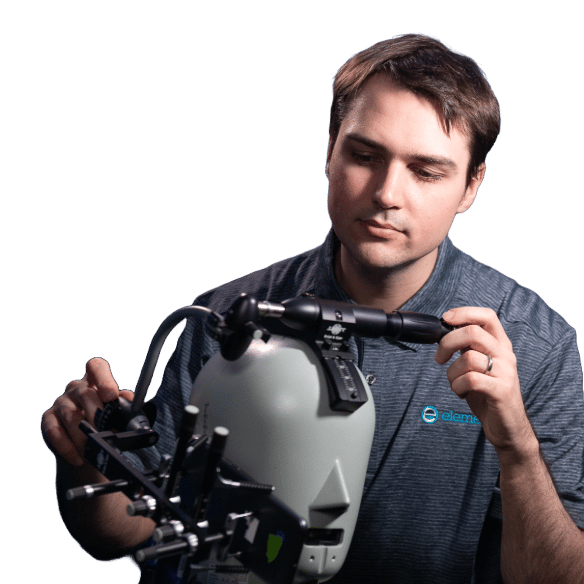
- Phantoms designed to hold various OTA device forms.
- OTA testing using head, hand, and forearm dummies for real-world usage simulation.
- Complete 2D and 3D passive and active antenna measurements to accurately characterize radiation patterns.
- 3D active tests with base station simulators for cell phones.
Cutting-edge equipment we use
Cutting-edge equipment we use
Your wireless device testing program demands precision equipment and technical expertise. Element's San Jose OTA Center of Excellence operates multiple CTIA-accredited, state-of-the-art OTA test chambers that enable rapid test scheduling. Our facilities support the latest 5G technologies and leverage best-in-class ETS-Lindgren anechoic chamber architecture to deliver accurate, repeatable results. Multiple Multi-Probe Anechoic Chambers (MPACs) are each equipped with 23 dual-polarized measurement probes that recreate controlled multipath radio environments for realistic OTA evaluation of 5G, MIMO, throughput performance, beamforming, and spatial performance. Our specialized antenna pattern measurement labs offer:
- Active testing from 600 MHz to 7.125 GHz.
- Passive testing from 400 MHz to 10 GHz.
- Supplemental testing for 28 GHz and 39 GHz mmWave bands.
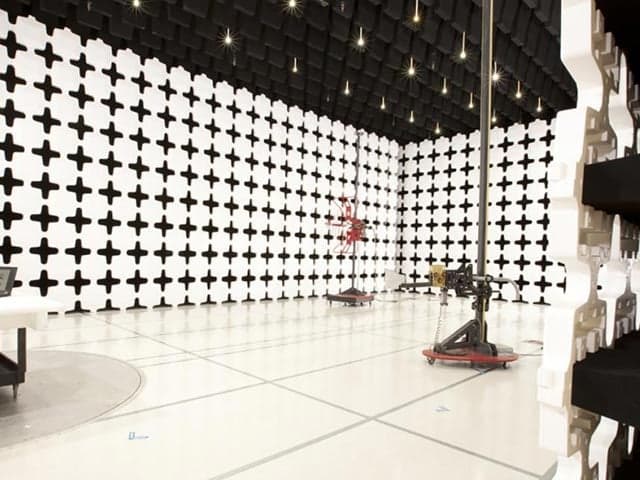
- Fully anechoic rooms (FARs) with minimized reflections.
- Integrated laser alignment systems for precise DUT positioning.
- High-speed switch controllers for accelerated testing.
- Expanded test zones for larger wireless devices.
- Industry-leading test equipment - Anritsu MT8000A, Keysight UXM, Rohde & Schwarz CMX500, etc.
Which labs offer this service
Which labs offer this service
As a CTIA-Authorized Certification Test Lab (CATL) and PTCRB Primary Test Lab for over 20 years, Element has over 65 years of combined OTA engineering experience across our team. We have the OTA expertise to understand PTCRB requirements for streamlined, efficient testing, and that enables seamless coordination with our other compliance services for complete product certification (FCC, ISED, CE/RED, carrier-specific, etc.). Our OTA testing services are available at:
- US – Columbia, MD (within walking distance of the FCC OET lab, about 30 minutes from Washington, D.C.).
- US – San Jose, CA (our OTA Center of Excellence in Silicon Valley).
Standards we test to and products we test
As a CTIA-Authorized Certification Test Lab (CATL) and PTCRB Primary Test Lab, Element performs testing to these CTIA and PTCRB certification requirements for customers in North America and worldwide, with test results that are recognized and accepted globally:
- CTIA Certification – Wireless Device Over-the-Air Performance Testing that includes TRP, TIS, radiated sensitivity, and A-GNSS performance. CTIA's OTA methodology is a key industry reference for radiated device performance.
- 3GPP – Cellular and 5G NR requirements that cover LTE, NR, RedCap, CAT-M1 and related technologies. For MIMO OTA specifically, 3GPP TS 38.151 defines NR UE MIMO OTA performance requirements.
- PTCRB/GCF Certification Support.
- Carrier-Specific OTA Test Plans – T-Mobile, Verizon, AT&T, and other operator-specific radiated performance requirements as needed.
For CTIA, we cover these two active test plans:
- CTIA Certification Test Plan for Wireless Device Over-the-Air Performance
- CTIA 01.01 Test Scope Requirements and Applicability V8.0.4
- CTIA 01.02 Operator Priority List V8.0.4
- CTIA 01.03 Normative Reporting Tables V8.0.4
- CTIA 01.04 Informative Reporting Tables V8.0.0
- CTIA 01.20 Test Methodology, SISO, Anechoic Chamber V8.0.2
- CTIA 22 Test Methodology, SISO, Millimeter Wave V8.0.0 (referencing List of Authorized 5G Millimeter Wave Over the Air Performance Test Equipment V1.1)
- CTIA 01.40 Test Methodology, MIMO, Static Channel Model, Multi-Probe Anechoic Chamber V8.0.0 (referencing List of Authorized MIMO Multi-Probe Anechoic Chamber Test Equipment V1.0)
- CTIA 01.50 Wireless Technology, 3GPP Radio Access Technologies V8.0.3
- CTIA 01.51 Wireless Technology, Location Based Technologies V8.0.4 (referencing List of Authorized OTA A-GNSS Equipment V1.4)
- CTIA 01.52 Wireless Technology Non-3GPP Radio Access Technologies V8.0.0
- CTIA 01.70 Measurement Uncertainty V8.0.2
- CTIA 01.71 Device Setup and Positioning Guidelines V8.0.1
- CTIA 01.72 Near-Field Phantoms V8.0.0 (referencing List of Authorized OTA Phantoms V1.0)
- CTIA 01.73 Supporting Procedures V8.0.0
- CTIA 01.90 Informative Reference Material V8.0.1
- Test Plan for RF Performance Evaluation of Wi-Fi(R) Mobile Converged Devices
- CTIA Certification Wi-Fi-Alliance Test Plan for RF Perf Eval of Wi-Fi Mobile Converged Devices V8.0.1
- CTIA Certification Wi-Fi-Alliance MRR Test Plan for RF Perf Eval of Wi-Fi Mobile Converged Device V8.0.0
Wireless consumer devices
- Smartphones and mobile phones
- Laptops and notebooks
- Tablets
- Smartwatches and wearables
Networking equipment
- Wireless routers
- Access points
IoT and smart devices
- IoT sensors and controllers
- Smart home devices
- Connected appliances
Industrial and commercial
- Industrial wireless controllers
- Commercial wireless systems
- Wireless monitoring equipment
Military and defense
- Military communication devices
- Defense wireless equipment
Transportation technologies
- Telematics systems and infotainment units (automotive and aerospace)
- Fleet management platforms
- In-vehicle infotainment
- Navigation systems
- Vehicle diagnostics
Your Challenges, Our Solutions
Discover Poor Antenna Performance Early
Master Different Carrier Acceptance Requirements
Navigate 5G Device Complexity
Minimize Cost of Retesting
Element Experts at your service


Why Choose Element

Hard-to-Find OTA Expertise
Unmatched PTCRB/OTA Knowledge
Recognized for OTA Testing Leadership
Silicon Valley Center of Excellence
7.125 GHzActive OTA testing from 600 MHz up to 7.125 GHz.
10 GHzPassive OTA testing from 400 MHz up to 10 GHz.
28/39Transceivers operate in 28/39 GHz mmWave bands for OTA testing.
23Each MPAC uses 23 probes for realistic 5G OTA evaluation.

Frequently asked questions
What makes Element a leader in OTA performance testing and single-source compliance?
Element brings 20+ years of OTA performance testing experience and standards leadership through technical contributions to 3GPP, PTCRB and CTIA. Round-robin and correlation testing with laboratories, network operators and OEMs validates measurement consistency, supporting repeatable, industry-aligned results.
As a preferred partner for leading U.S. carriers—and, in some cases, their exclusive OTA provider—Element supports simultaneous multi-carrier certification to accelerate time to market. Results are recognized by major U.S. operators and accepted by PTCRB and GCF.
Our single-source offering combines wireless device, module and chipset testing with Electromagnetic Compatibility (EMC) testing, Electrical Safety testing, regulatory certifications and Global Market Access (GMA) support under one roof.
Is OTA testing required for IoT and low power devices?
In many cases, yes. Cellular IoT devices, including LTE‑M (Cat‑M1), NB‑IoT, and other connected products, often require OTA performance validation and carrier-specific approval prior to deployment. Element’s OTA testing helps verify antenna performance, wireless connectivity, and radio efficiency under real-world operating conditions to ensure devices meet certification, regulatory, and network acceptance requirements.
Element's OTA experts support low-power and IoT device programs by evaluating performance across a wide range of wireless technologies and use cases, including Massive Machine-Type Communications (mMTC) applications to help manufacturers achieve reliable connectivity, compliance, and faster market access.
Do I typically need OTA testing for carrier certification, and how can Element help?
OTA testing is often required for PTCRB/CTIA certification and many U.S. carrier acceptance programs although the specific requirements depend on the device, technology, and target market. Element can help determine the applicable OTA test scope and certification pathway for your product. As a recognized test partner for major U.S. carriers, Element performs the required OTA, PTCRB, CTIA, and carrier-specific testing to support certification and market entry. Element is officially accredited for Verizon 5G FR1 OTA carrier acceptance testing (including Verizon Fast Track eligibility) and for T-Mobile 5G OTA testing capabilities.We can help streamline multi-carrier approval by testing to Verizon, T-Mobile, and other applicable carrier requirements under one roof while providing the testing services required to support entry into the AT&T AQT process, including PTCRB and TRENDI testing.
What makes 5G NR OTA testing so complex, and how does Element address these challenges?
5G NR OTA testing is complex because of diverse performance demands, network architectures and antenna technologies; Element addresses these through comprehensive U.S.-market testing and performance characterization.
- eMBB: higher capacity and faster throughput.
- URLLC: mission-critical communications with latency as low as 1 ms.
- mMTC: low-power, low-bandwidth connected devices.
Testing covers both architectures:
- NSA: LTE anchor with an added 5G bearer for capacity and speed.
- SA: fully 5G radio access and core, without an LTE anchor.
Element also evaluates:
- NSA/SA modes.
- FR1 sub-6 GHz and FR2 mmWave.
- Massive MIMO’s multiple transmit/receive antennas.
- Directional beamforming.
- Carrier-required higher-order EN-DC combinations.
- Multi-radio coexistence
- Small-cell/mmWave network densification.
Advanced facilities and certification expertise validate performance, identify design issues early and streamline carrier, PTCRB, CTIA and regulatory compliance.
For OTA (Over-the-Air) testing, what are the key differences between active and passive testing?
Active OTA testing evaluates a complete device with its radio transmitting and receiving; passive OTA testing characterizes its antenna with the radio inactive.
Active testing uses controlled anechoic-chamber conditions to capture the combined effects of the antenna, RF circuitry, enclosure and system design on end-to-end performance, throughput, coverage and MIMO. Metrics include Total Radiated Power (TRP), Total Isotropic Sensitivity (TIS), Effective Isotropic Radiated Power (EIRP), Effective Isotropic Sensitivity (EIS), throughput (Mbps), MARSS and TRMS.
Passive testing uses a controlled RF connection in an anechoic chamber to evaluate antenna behavior across frequency, angle and polarization, independently of active transmitter/receiver functions. Measurements include gain (dBi), efficiency (%), directivity (dBi), radiation patterns, polarization and impedance matching through VSWR and return loss (dB).
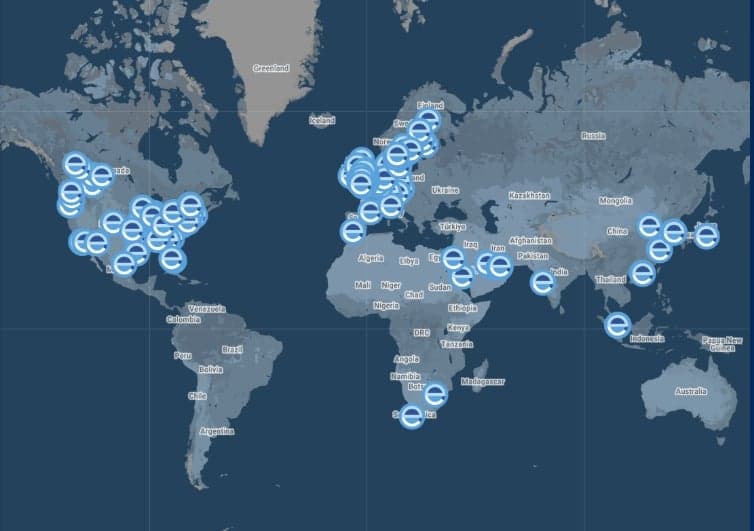
Explore our global network of labs and find your nearest location
VIEW ALL LOCATIONSBut don't just take our word for it
See what others have to say about partnering with Element
Related Services
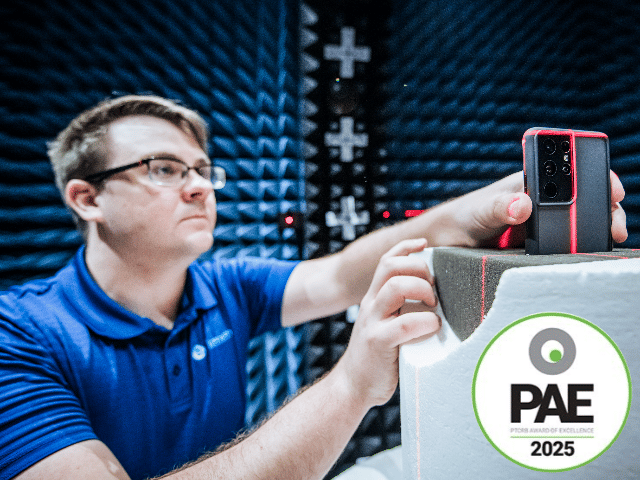
PTCRB Certification
PTCRB certification for 5G NR, 4G LTE, Cat M, and NB-IoT devices. Element is a Primary Lab and 2-time PTCRB Award of Excellence winner.

Wireless Device Testing & Certification
Get your wireless devices to market faster with Element's accredited testing services. Expert guidance through compliance, certification and global approvals for all wireless technologies.

Cellular Device Testing & Certification
Accelerate market readiness with Element's Over-the-Air (OTA) Testing Services. Verify wireless device performance in real-world conditions, identify issues early, and meet global standards with global expert-led testing.
Electromagnetic Compatibility (EMC) Testing & Electromagnetic Interference (EMI) Testing & Certification
Element provides accredited EMC and EMI testing and certification services, helping businesses meet regulatory requirements, reduce costly redesigns, and bring products to market faster through expert compliance support.

Radio Frequency (RF) Testing & Certification Services
Accelerate time-to-market with Element's end-to-end RF testing and certification services. Our expert engineers ensure your wireless devices meet global regulations, prevent interference issues, and perform optimally.
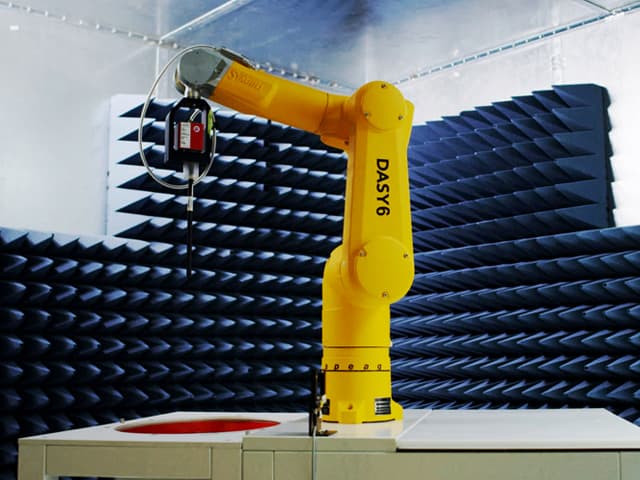
Specific Absorption Rate (SAR) Testing
Accelerate market entry with Element's Specific Absorption Rate (SAR) testing. Our advanced DASY6 technology ensures wireless devices meet RF exposure standards across US, EU, and Asian markets, while optimizing device performance.


