

Moog and Element create a unique multi-axis shaker table – Meeting high-frequency EV testing demands

This case study details Element's collaboration with Moog to upgrade a multi-axis shaker table, enhancing its capabilities to test electric vehicle (EV) components. The upgraded system achieves frequencies up to 150Hz, simulating real-world conditions for EV batteries and electronics.
Background
The widespread adoption of electric vehicles has changed many aspects of how new vehicles are tested, often requiring new equipment and methods to produce accurate results. Element recently partnered with Moog to make specialized upgrades to a multi-axis shaker table, allowing it to meet the parameters necessary to test EVs. This case study was originally published by Automotive Testing Technology International and has been shared here with permission from the publisher.
In the world of automotive R&D, hydraulic simulation tables are a workhorse for performing tests on everything from what’s under a vehicle (for example, transmissions and suspensions) to inside the cabin (for example, seats and headrests). As OEMs increasingly develop EVs, engineers face new design challenges that experts say standard test and simulation equipment can’t handle.
The challenge
“Auto industry simulation tables can typically reach 50Hz; but EV testing requires much higher frequencies, up to 150Hz,” says Kevin Oliverio, department manager for hydraulics at Warren, Michigan-based Element Materials Technology.
According to Oliverio, most vibration testing on automotive suspensions and components starts to roll off around 50Hz. But EV battery components require much higher thresholds. Higher-frequency testing, up to 150Hz, enables automakers and battery designers to simulate a capacitor’s ability to deal with vibration, assess how well soldering bonds stand up, and accurately view the rate of charge and discharge under all conditions.
Element began testing battery components seven years ago on a traditional simulation table for a large automotive OEM. As the auto industry kept pushing the boundaries of EVs, Element sought to expand its capability with high-frequency testing.
The solution
Element approached Moog with our need for high-frequency battery testing. Element’s request was to upgrade our existing Moog multi-axis shaker table, or MAST, which the motion-control company had installed several years ago at Element’s Warren facility. Moog responded by quickly developing a dual servo valve manifold upgrade, allowing the Moog MAST to achieve the higher frequency required to perform EV battery testing.
Element disassembled the hydraulic actuators on the table and shipped them to Moog for re-engineering. Moog modified the design, performed the upgrade, and reassembled and tested the actuators. In a few weeks, the team reinstalled the upgraded high-frequency table at Element for use on a large, incoming OEM order.
“We looked at our existing system at Element in terms of acceleration and displacement and worked with them to beat the performance specifications,” says Larry Rogers, associate key account manager for automotive testing at Moog. “All six actuators have to be controlled exactly in terms of speed and time, and that’s a significant challenge when the table has to vibrate at up to 150Hz.”
The result
The upgraded, high-frequency Moog MAST can test vehicle components, including batteries and electronics, for vibration and durability and reproduce data collected on proving grounds. Underpinning Moog’s high-frequency shaker table is a six-leg hexapod (or Stewart platform), which the company originally developed for flight simulators. The hexapod has two equilateral triangular frames set one above the other, offset at 30°. Each apex of the top triangle is connected to the two apexes below it on the lower triangle via Moog actuators.
Moog’s engineers designed the new table to reach frequencies up to 200Hz. The high-frequency Moog MAST includes a table measuring 2,300 by 2,000mm and an actuator peak force of 53kN, handling system payloads of up to 600kg. The battery packs going into some EVs on the market include as many as 2,500 batteries, which can weigh 450kg or more. Like traditional systems, the Moog MAST at Element has six degrees of freedom, moving the table in the x, y, and z axes, with rotational movements over all three (i.e., pitch, roll, and yaw).
Oliverio says Element has combined the high-frequency table from Moog with the motion-control company’s test software and the Moog Test Controller to test EV battery packs in ways not possible until now. With the test controller and a power spectral density profile, Oliverio and his team can run a vibration test on a large battery pack before the OEM puts the vehicle on the road to see what shakes loose. This enables Element to get involved in the vehicle maker’s design and development process much earlier. The insight gained early in the process can then be applied to automobile specifications and use cases. Oliverio says customers are now coming to Element to take their testing a step further and replicate data they have collected from a proving ground or verify an EPA model with the new high-frequency shaker table.
“Real-time replication with 6DOF, especially for battery packs, is the next, big wave of testing,” Oliverio adds. “Other EV makers, like Tesla, are focused on the in-cabin gadgetry, so testing how that holds up is a priority, too.”
Oliverio says one advantage of working with Moog to upgrade the table versus buying a completely new system was the cost, another was the engineering know-how. “We’re now running live battery-pack charging and discharging in an environmental system at 150Hz; there may be less than ten other locations in the world that can offer that,” he remarks. “We’re running headfirst into the battery game, and high-frequency testing is getting us return customers and a line-up of new ones.”
Why Choose Element
Proven Industry Partnerships
Advanced Simulation Tools
Custom Upgrades for EV Testing
End-to-End Environmental Systems
200Hz Supports high-frequency operation for precise control
600kg Handles system payloads up to this maximum
2,300 x 2,000mmTable size providing a large working surface
53kN Peak force output of the actuator
Related Services
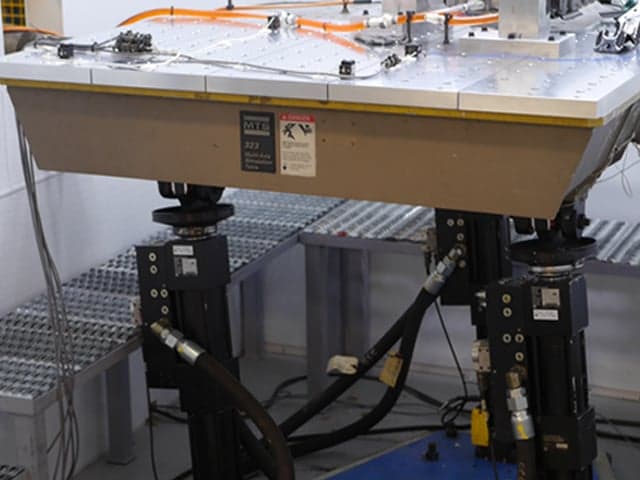
Multi-Axial Simulation Table (MAST) Testing Services
Element's MAST testing replicates real-world vibrations in a controlled lab, helping automotive engineers assess durability, reduce development time, and refine vehicle components for safer, more reliable performance.
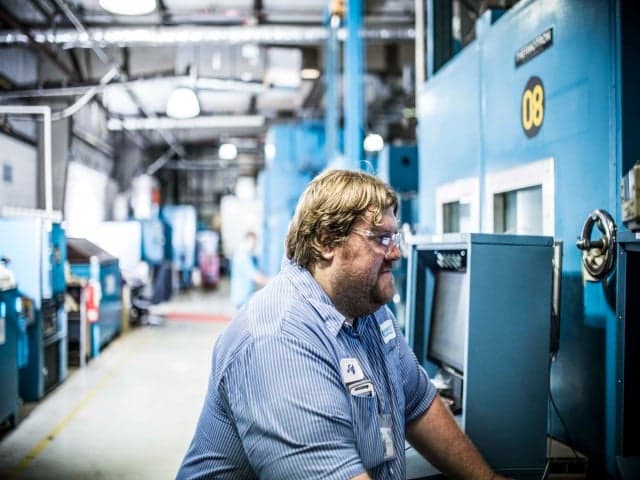
Combined Environmental Simulation Testing
Accelerate your product development with Element's combined environmental simulation testing services. Ensure compliance while saving costs.