

Cold Plume Dispersion Analysis for Rooftop Air Source Heat Pumps
This article by Przemek Winiecki presents a cold plume dispersion analysis for rooftop air source heat pumps installed at Kensington Leisure Centre. Element's Digital Engineering team utilized Computational Fluid Dynamics (CFD) simulations to assess thermal impacts, noise pollution, and potential ice formation risks.
Background
Lancaster West Neighbourhood which is part of the Royal Borough of Kensington and Chelsea (RBKC) were planning to install air source heat pumps on the roof of the Kensington Leisure Centre. They approached us to better understand how these installations might affect the surrounding environment, local communities, vegetation on the roof, and possible ice formation.
The image above depicts the Kensington Leisure Centre.
The challenge
The installed air source heat pumps were designed to extract heat from ambient air. Once the heat has been extracted, it is dispersed back into the environment at a lower temperature. RBKC acknowledged that this colder air might pose a potential thermal comfort risk to residents. Our initial study showed that the thermal impact of installing these pumps would be negligible. The bigger concern was the noise generated by the pumps during continuous operation, so the Council decided to explore options to reduce noise pollution.
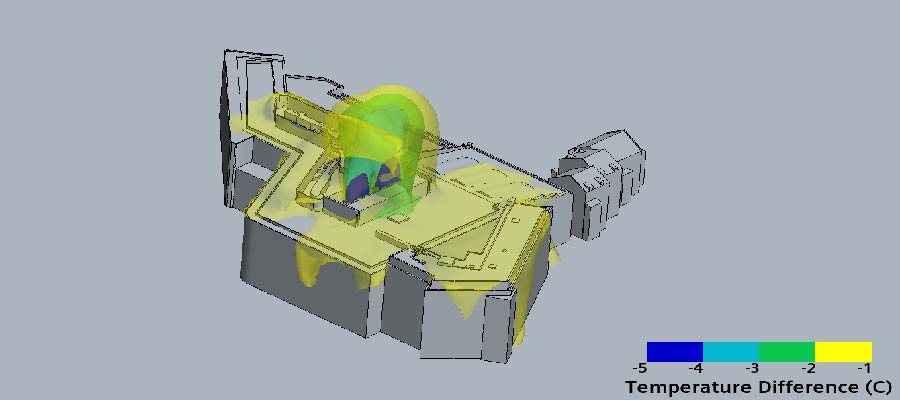
Above, the CFD model shows the temperature difference in the area around the heat pumps.
The approach
We began by collecting historical wind data, fitting it to a Weibull distribution, and developing a Computational Fluid Dynamics (CFD) model. This allowed us to calculate temperature differences between the pump efflux and ambient air. We also assessed the impact of wind speed, direction, and temperature, along with the heat pump operating conditions. In the second phase, we updated the computational model to include acoustic hoods. We found that these hoods had a negligible impact on temperature distribution while reducing noise pollution.
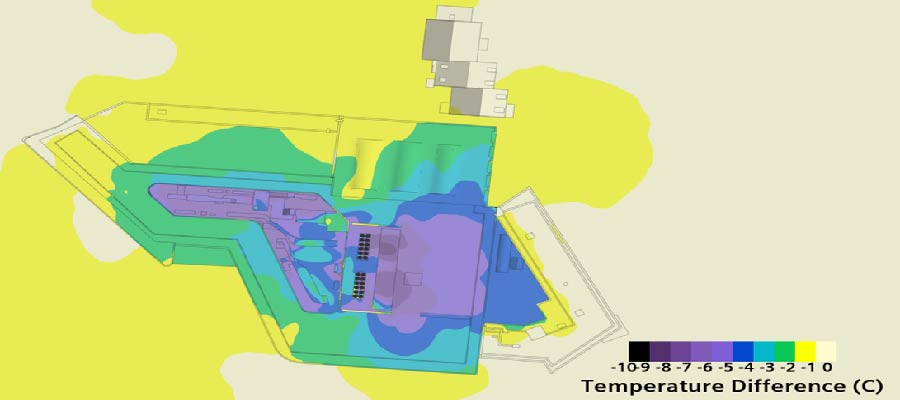
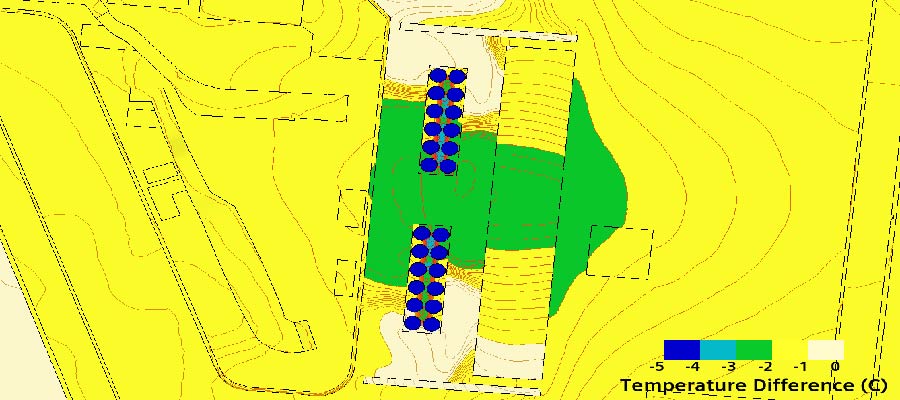
Above, the CFD model shows the impact of reduced fan flow. Below, we see the impact with the acoustic hoods installed.

The result
Our data-driven analysis gave RBKC confidence that installing heat pumps would have a negligible impact on human thermal comfort and plant life on the roof. However, we found there would be a risk of increased ice formation on the rooftop, as temperatures might drop by up to 3°C in the assessed conditions. Moreover, we discovered that the presence of acoustic hoods both reduced the temperature drop and limited the spread of colder air to an area closer to the heat pumps.
Related Services
Computational Fluid Dynamics
We use Computational Fluid Dynamics (CFD) to simulate and analyze complex problems involving fluid-fluid, fluid-solid, and fluid-gas interactions.
Advanced Modeling and Simulation Services
Elevate your project with Element's modelling and simulation services, including fluid simulation, CFD, FEA, DEM, and electromagnetics. Our industry-leading expertise ensures precision, cost savings and regulatory compliance at every step.