

Powering Green Rail Solutions: How Element Digital Engineering Provided Route Assessment for Battery Powered Train

This case study explains how Element Materials Technology assessed whether a large battery system could power an electric train over a partially unelectrified route. Using detailed modeling of route gradients, friction, acceleration and charging schedules, the study confirmed viability while highlighting scenarios needing enhanced charging infrastructure.
Background
Battery powered train concept
The UK rail authorities are aiming to eliminate diesel traction wherever possible, but the network itself does not yet have complete electric coverage, and it will be many years before that is achieved. However, there are many routes that are partially electrified, operating with either occasional gaps in electrical coverage, or overhead wires that do not extend the full length of the line.
A major UK rail leasing companies was looking for a solution to such a route, and approached Element Digital Engineering, to assess whether a large battery could provide the power to take an electric train along an unelectrified section at the end of the line.
The challenge
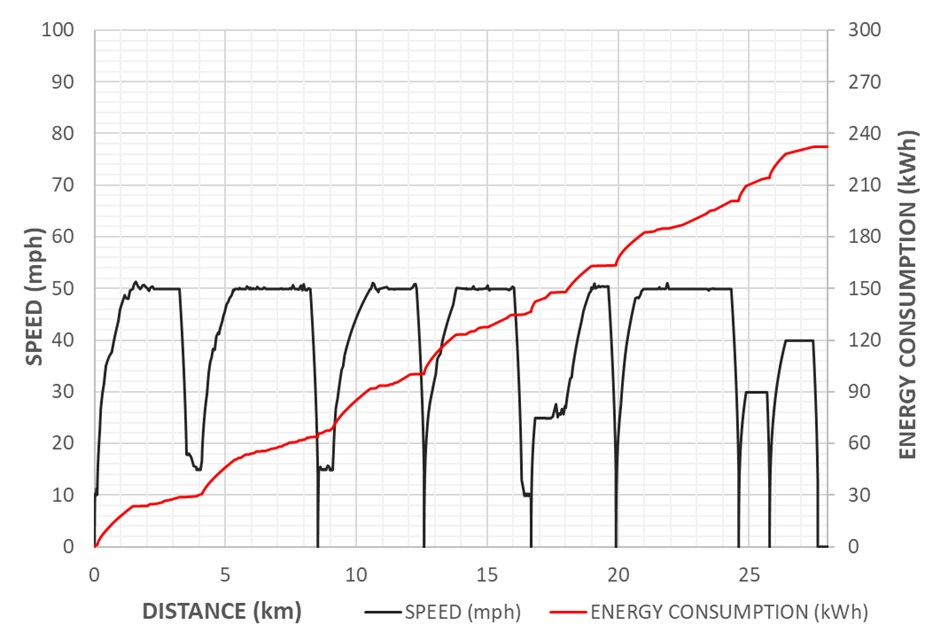
The first challenge was to assess the energy requirement for the route. A model was needed that considered the gradients on the line, friction caused by bends and points, acceleration away from stations and the possibility of unplanned stops at signals.
The second challenge was charging time. The battery would charge during its time on the electrified portion of the line and then again at a charging point at the station at the end of the non-electrified section. The model had to consider whether the timetable allowed enough time for sufficient charge to be taken on at these times, and whether an intermediate charging point might be necessary for times when the schedule was disrupted.
The solution
We built a dedicate route model of the line incorporating all the geographical features and details of the line itself. A very large number of simulations were then run, considering all possible combinations or operating events.
The result
We were able to confirm that a battery was a viable solution and could provide extremely good performance and service in nearly all operating conditions. However, there were some cases where battery depletion would mean more time would be needed to recharge at the end of the line, and an upgrade to the charging equipment was recommended.
Why Choose Element
Comprehensive Digital Modeling
Transportation Sector Expertise
Sustainability-focused Engineering
Risk-reducing Analysis
Related Services
Advanced Modeling and Simulation Services
Elevate your project with Element's modelling and simulation services, including fluid simulation, CFD, FEA, DEM, and electromagnetics. Our industry-leading expertise ensures precision, cost savings and regulatory compliance at every step.
AREMA Chapter 30 Rail Simulation Programs
Element's AREMA Chapter 30 rail simulation programs replicate real-world conditions to assess failures, material wear, and durability. We help rail organizations improve performance, extend product lifespan, and meet compliance standards.

Rail Infrastructure Services
Element provides accredited rail infrastructure testing and inspection services to improve material performance, prevent failures, and maintain compliance with industry standards.