
Battery Safety Beyond the Lab: Logistics and Storage Risks
Battery safety risks extend far beyond regulatory compliance, with downstream failures emerging across logistics, storage, and end-use environments even when standards such as UN 38.3 are met. Written by Emily Klein, this whitepaper is intended for engineers, compliance managers, and safety stakeholders working across the battery supply chain. It finds that most incidents arise from a combination of handling practices, state-of-charge mismanagement, environmental exposure, and inconsistent application of transport guidelines. The conclusion is clear: compliance is a baseline, not a guarantee of safety, and effective risk reduction requires continuous training, process discipline, and real-world validation
WHY DOWNSTREAM BATTERY RISKS MATTER
A downstream risk refers to any hazard or issue that arises once a cell, battery, pack, or module has left the manufacturer. Prior to shipment, batteries undergo extensive testing, spanning the early stages of development through final qualification, to improve performance and ensure safety throughout their lifetime. Standards and regulatory tests establish baseline requirements, helping to reduce the likelihood of incidents by ensuring every cell or battery meets minimum safety criteria. Downstream risks can manifest in many ways, from logistics, shipping hazards, failures during consumer use, challenges in recycling and disposal at endof-life. Each of these stages introduces unique conditions—mechanical stress, improper charging, environmental exposure, or unsafe handling—that can trigger incidents. As battery products become increasingly commercialized and widely used, the sheer scale of deployment makes incidents statistically inevitable, even when standards are met. This underscores the importance of understanding the factors that drive downstream risk; not only to appreciate the role of existing tests, but also to identify gaps and opportunities where additional measures may be necessary to further enhance safety and reliability. To mitigate risk, a variety of established tests are in place to ensure the safe transport of batteries, yet their effectiveness ultimately depends on how the associated guidelines and training are applied. Many logistics teams provide training that addresses general awareness, function-specific safety, classification, packaging, labeling, and documentation requirements for shipping batteries. While this training is valuable for day-to-day roles, it often relies heavily on personnel correctly following guidelines and assumes that prior product testing guarantees safe transport. In practice, these guidelines are not always applied consistently, and logistics teams may lack specialized battery-safety expertise to notice warning signs. Downstream risks carry significant weight, as any incident can pose a direct threat to public safety and harm business reputation.
“Safety testing is an ongoing, evolving process, shifting the focus from checking boxes to refining methods that uncover gaps and drive continuous improvement.”
REAL WORLD INCIDENTS:
2024 California Highway Incident: A truck carrying lithium batteries caught fire, released gases, and closed freeway lanes. Critical Mineral Recovery Facility: The facility which discharges, dismantles, and processes materials for batteries experienced a fire that resulted in a shelter in-place order for surrounding areas. Lakeville Laptop Fire: A teen’s laptop caught fire due to what is believed to be started by an overheated battery. Luckily the teen and her grandmother were able to successfully put out the fire. Cambridgeshire Laptop Fire (UK): While unpacking a new laptop it caught fire, the person that unpacked the laptop was treated for minor burns. While the exact cause was not determined it is believed to been due to the battery. Southwest Airlines Flight Diversion: Passenger cell-phone fire in overhead bin led to unscheduled landing
FAA LITHIUM BATTERY INCIDENT DATA
The FAA tracks reported events involving smoke, fire, or extreme heat; while not comprehensive, the data provides a useful view of failure occurrence and product types.
626 verified smoke/fire/ heat incidents (2006– 2025) Peak years: 2023 (89) and 2024 (77 YTD) Of these, 469 on passenger aircraft, 131 on cargo flights Incidents through June 2nd 2025: 28 incidents
WHAT THIS TEACHES
Battery-related incidents are occurring with increasing frequency, largely due to three converging factors: the rising number of batteries in circulation, limited education on proper handling and transportation, and the growth of global supply chains that introduce both inexperienced suppliers and, in some cases, deliberate bad actors. These incidents illustrate a critical reality: battery safety risks are not confined to specialized environments such as aircraft cargo holds or research laboratories. Instead, they manifest across the full spectrum of logistics and end-use environments, from highways and processing plants to local warehouses and distribution centers. This broad exposure shows the need for vigilance at every level of the logistics chain and across every type of device, regardless of size or chemistry. Equally important is the recognition that small-scale incidents, such as package-level failures or device malfunctions, are just as valuable to track and analyze as large-scale cargo fire events. Each occurrence, whether minor or catastrophic, provides insights into failure modes and prevention strategies. Incorporating lessons from both ends of the spectrum strengthens the industry’s ability to design, test, and implement more robust safety measures, while also advancing education and awareness for those who handle or ship batteries. For a cell or battery to become a safety concern, certain conditions typically converge. These may include a sufficiently high state of charge, external stressors such as elevated ambient temperature or mechanical vibration, and the presence of an internal or external short circuit. When these triggers align, the risk of thermal runaway or propagation increases significantly. While a full-scale thermal event represents the most hazardous outcome, with potential for fire, gas venting, or explosion, even less severe manifestations, such as reduced performance or capacity fade, can have serious implications. They not only degrade the functional quality of the cell but also erode consumer trust and the reputation of the brand. As such, both catastrophic safety events and sub-catastrophic degradation events must be addressed with equal seriousness when evaluating risk and developing mitigation strategies. In the examples shown, it is clear that every case ultimately resulted in a fire. Unsurprisingly, the more dramatic the incident, the more likely it is to be reported by news outlets or circulated publicly. In some instances, the exact cause remains unknown due to limited evidence—once a cell fails, it is often difficult or impossible to determine its state of charge, whether any visible mechanical damage was present, or if early warning signs such as swelling had appeared.
If we make some assumptions, however, we can examine cases like the Cambridge laptop fire. For instance, if the individual unpacking the device did not drop or damage it (noting that both the laptop and its battery should have passed standardized drop tests), then the cell would likely have been at a relatively high state of charge to enter thermal runaway. While it is possible for a cell at a lower state of charge to fail, doing so typically requires more severe abuse—such as higher sustained heat—compared to a cell charged above ~70%. If that assumption holds true, it suggests the laptop left the facility at a state of charge above the recommended 30% level for shipping. This raises important questions: how and why did this occur? If a product with a battery is shipped at a higher state of charge, it is critical to identify the stage in the process that allows it to pass through without correction. In consumer shipments, many people are unaware that devices should be discharged prior to transport, and even those who do know often lack the means to safely reduce the charge. If these conditions are accurate, we must ask—what can be done to address this gap?
POTENTIAL HAZARDS IN TRANSIT
- Vibration and shock from rough roads or air turbulence
- Charged batteries more prone to thermal runaway
- Undeclared batteries in mixed-cargo shipments
- Environmental effects like vibration, temperature, and humidity
- Potential for mechanical damage STORAGE
- Inadequate spacing
- Shared racks
- High temperatures
- Lack of surveillance
LABELING & DOCUMENTATION FAILURES
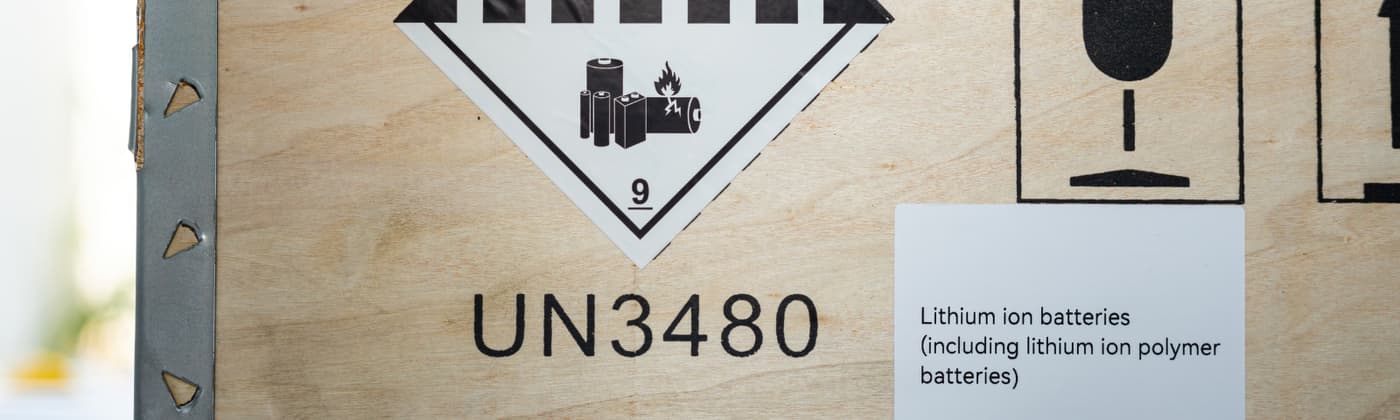
- Missing UN numbers (e.g., UN3480, UN3090)
- Absent Class 9 hazard and CAO labels
- No PHMSA Test Summary available upon request
- Reused or damaged packaging obscures markings
“Understanding the mistakes and hazards made in battery logistics helps avoid damage to you, your product, and your customers.”
REGULATORY COMPLIANCE UN38.3 TESTING OVERVIEW
Eight required tests: altitude, thermal, vibration, shock, crush, short circuit, overcharge, and forced discharge UN 38.3 exists to demonstrate that lithium cells and batteries can withstand normal transport conditions (altitude, thermal cycling, vibration, shock, short-circuit, impact/crush, overcharge) before they are distributed. It originates in the UN Manual of Tests and Criteria, Part III, sub-section 38.3, and is referenced worldwide by transport rules. Interestingly in the United States, if wanted to start making lithium-ion cells in your garage you can technically legally do this, although not advisable; however, the moment you ship them, the federal Hazardous Materials Regulations (HMR) apply. Under 49 CFR 173.185, every lithium cell or battery you offer for transport must be of a type proven to meet UN 38.3, and manufacturers/ distributors must make a UN 38.3 test summary available. This is in addition to meeting the packaging, marking/ labeling, and documentation provisions of the HMR and, for air shipments, ICAO/IATA rules (including the 30% SoC limit for standalone Li-ion by air). In the U.S. many “standards” (e.g., the UN test procedures) become de-facto mandatory because they are incorporated by reference into regulations; by contrast, non-incorporated industry standards may guide best practice but are not, by themselves, legally required. Outside the U.S., transport regimes similarly require UN 38.3 type testing via ADR (road in Europe), RID (rail), IMDG (sea), and ICAO/IATA (air) so shipments move under harmonized rules; the EU goes further with Regulation (EU) 2023/1542, which adds lifecycle obligations (labeling, documentation, sustainability/traceability) beyond transport compliance.
PHMSA TEST SUMMARY (TS) REQUIREMENTS
Within the U.S. Pipeline and Hazardous Materials Safety Administration (PHMSA) has required manufacturers to publish a Test Summary(TS)for every lithium cell and battery contained in a product except for button cells installed in equipment. While the TS does not have a set form or format it must include all required elements/ This can included listing the manufacturer and test laboratory’s full contact details, which enabling any downstream shipper to verify compliance. A unique report ID and date of issue link each TS to its test data. The document also describes the cell or battery’s physical attributes like mass, capacity and chemistry. Finally, a responsible individual must sign off, attesting to the TS’s accuracy and completeness. In short: PHMSA is the U.S. agency that turns UN 38.3 from an international standard into a legal requirement for transport. It is why you can build cells in your garage for personal use, but the moment you ship them—even across town—PHMSA rules (and thus UN 38.3 compliance) apply. responsible individual must sign off, attesting to the TS’s accuracy and completeness.
COST & CONSEQUENCE OF NON-COMPLIANCE
FAA/PHMSA fines
- Shipment delays or rejections by carriers
- Insurance premium hikes, legal liability
- Brand and reputational damage
BEST PRACTICES
Even after cells and batteries have passed regulatory testing and meet shipping requirements, risks remain throughout logistics, storage, recycling, and handling. Implementing consistent best practices is essential to minimize hazards, protect personnel, and maintain compliance. These practices are not limited to technical controls, but also depend on process discipline and training. The following measures have proven especially effective: Verify state of charge (SOC): Ensure all samples are below 30% SOC before shipment or storage. Because Element receives samples from many different clients, we are aware that this step is sometimes overlooked, yet it remains critical for reducing the likelihood of a thermal incident. It is also important to recognize that not everyone has the ability or equipment to discharge cells, in these cases it may require different accommodation. For example, cells or batteries above 30% SOC cannot be shipped on passenger aircraft, but could be shipped by cargo aircraft with a full Class 9 Dangerous Goods declaration and more robust packaging. Confirm regulatory compliance: All required testing, such as UN38.3, must be completed, with documentation and labeling that is easily accessible. This can be challenging when working with smaller suppliers or during the qualification phase of production. In cases where cells are purchased in low quantities, obtaining consistent, high-quality samples and full documentation (such as SDSs) can be difficult. As these issues become more common, we have had to adapt our incoming procedures to manage samples with limited information. Segregate by condition and chemistry: Where possible, separate batteries by chemistry, age, or condition. Although full segregation is difficult in large-scale operations, consistent separation by condition and chemistry significantly reduces risk and improves traceability. Consider anonymous product acquisition: As a manufacturer, one unique option is to anonymously purchase or acquire your own product to evaluate whether it arrives in the expected condition. In some cases, customers have uncovered mechanical defects or discovered that products were shipped above the recommended 30% SOC threshold. This approach not only highlights potential quality or compliance gaps, but also helps pinpoint which process steps require improvement. Invest in training and awareness: Training should reach all personnel involved in battery handling—warehouse staff, transport teams, technicians, and quality personnel. Everyone should be able to recognize risks, identify warning signs, and know when to stop work. A “stopwork authority” policy, which Element has implemented, empowers anyone on site to pause operations if safety concerns arise, ensuring proactive risk management.
Battery safety does not end with design qualification or regulatory testing. Once cells, packs, or modules leave the manufacturer, they face downstream risks throughout logistics, storage, consumer use, and endof-life processing. Mechanical stress, improper charging, environmental exposure, and mishandling can all trigger failures even when standards such as UN38.3 are met. Real-world incidents—including highway fires, recycling facility events, laptop fires, and in-flight cell phone failures— demonstrate how battery hazards emerge across the supply chain. FAA data confirms the scale of this challenge, with over 600 smoke, fire, or heat events reported since 2006, peaking in recent years. These cases highlight the importance of managing state of charge, ensuring proper packaging and documentation, and closing gaps in training and awareness. To mitigate these risks, compliance with regulations is essential, but may not be sufficient on its own. Best practices such as keeping batteries at or below 30% state of charge and auditing shipments through anonymous product acquisition strengthen safety in practice. Just as important is investing in training and empowering personnel with stop-work authority to act on concerns. Ultimately, safety testing should not be viewed as a onetime requirement but as a dynamic, evolving process. By treating failures as opportunities for insight and improvement, the industry can reduce incidents, protect public safety, and build trust in battery technology. What recent lessons—whether from incidents, near misses, or customer feedback—has your team used to improve battery logistics and storage safety?
By Engaged Expert