

Poly and Perfluoroalkyl Substances (PFAS): Answering your most Frequently Asked Questions
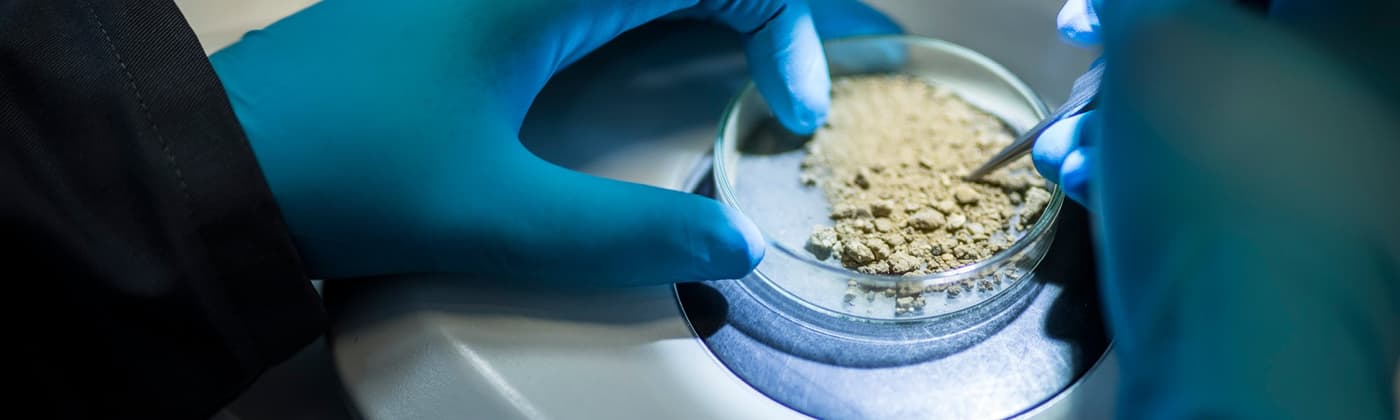
This article provides an in-depth overview of per- and polyfluoroalkyl substances (PFAS). It explains their widespread industrial use, persistence in the environment, potential health risks and current regulations. The article also details how analytical laboratories, such as Element Deeside, analyse for the presence of PFAS substances in water and soil samples.
Deepen your knowledge of PFAS substances and existing regulations with these commonly asked questions.
PFAS overview
What are PFAS substances?
PFAS are a large group of man-made synthetic organofluorine chemicals including PFOA, PFOS, and GenX. There are >5,000 known compounds.
PFAS have at least one fully fluorinated methyl (–CF3) or methylene (–CF2–) group, with the carbon-fluorine bonds (C–F) imparting high thermal stability and resistance to degradation, making them useful in a wide variety of products. However, they are persistent and bio-accumulative, meaning they do not break down in the environment, and can readily migrate to the air, water, soil, and food, potentially causing harmful effects on human health.
The Interstate Technology & Regulatory Council has prepared a PFAS Technical and Regulatory Guidance Document, updated September 2023 (https://pfas-1.itrcweb.org/wp-content/uploads/2023/12/Full-PFAS-Guidance-12.11.2023.pdf ) which provides a PFAS family tree (Figure 2-4), reproduced below. This captures some of the wide variety of PFAS compounds including two primary classes: polymers and nonpolymers. Each class may contain many subclasses, groups, and subgroups, some of which are shown in the figure below.
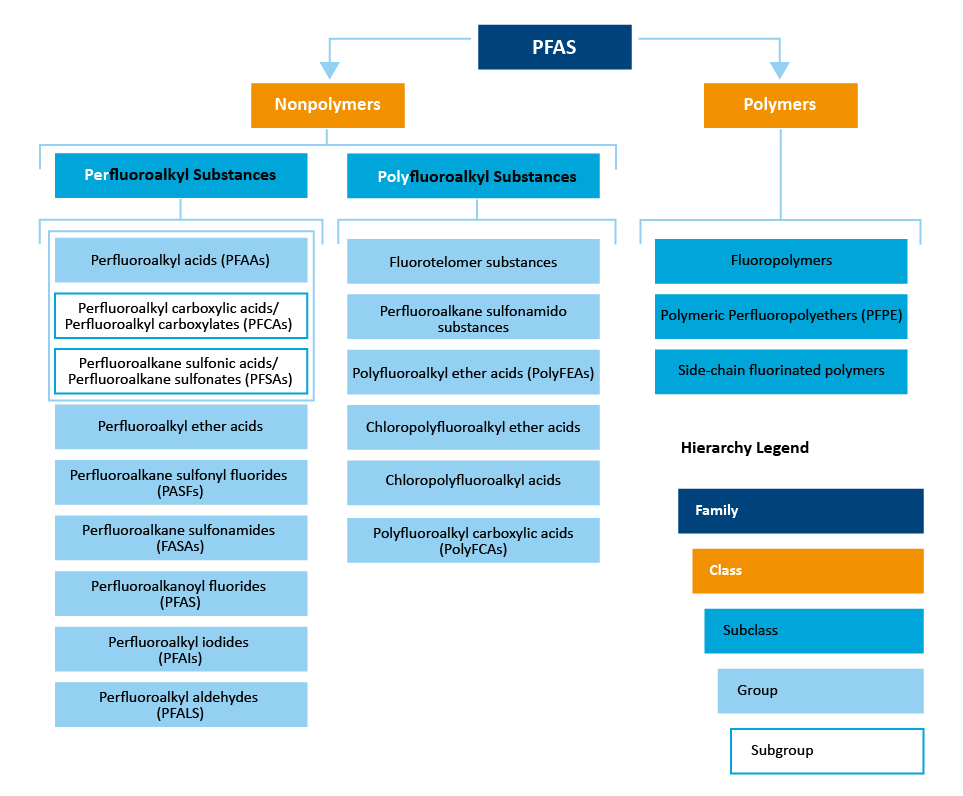
Some PFAS - such as some polyfluorinated alkyl substances - can partially degrade or transform in the environment. The end degradation products are typically perfluoroalkylated acids (PFAAs), most commonly perfluoroalkylated sulfonic acids (PFSAs) and perfluoroalkylated carboxylic acids (PFCAs) which are highly resistant to further degradation. PFAAs can persist in the environment for decades or longer and are sometimes referred to as ‘forever chemicals’.
What are PFAS used for?
PFAS have been widely used in industry and manufacturing since the 1940s in a diverse range of applications, including surface coatings for non-stick cookware, carpets, soft furnishings, paper, leather, and metal and performance chemicals, like cleaning agents and firefighting foams.
Due to their ability to repel water and oil, as well as their heat resistance, PFAS are widely used as non-stick and stain-resistant agents, as surfactants, and in polymer manufacture. In recent years concerns have increased about potential health risks due to their persistence in the environment.
Point sources of contamination may include sites with current or historical uses comprising:
- Petrochemical facilities
- Textile and leather manufacturing
- Paper and board manufacturing
- Metal plating/etching
- Sites that have a history of using firefighting foams such as airports, military bases, large industrial facilities
- Landfill sites
- Wastewater treatment facilities
Are PFAS substances regulated?
Regulatory focus on PFAS is steadily increasing to protect against perceived risks to human health and the environment. PFOS is already listed in the Stockholm POP convention, and the UN has recommended a global ban on PFOS and PFOA. Their use is already highly restricted in the UK and EU, as well as in other countries.
Many countries have adopted drinking water guidelines ranging from 0.01µg/l up to 1µg/l and the EU has set a sub ppt Environmental Quality Standard of 0.00065µg/l for PFOS (to be achieved by 2027). Guideline values in the ppb ranges are also being established for soils by many other countries.
The EU includes 20 PFAS substances within Annex III of EU Drinking Water Directive 2020/2184 and is consulting on prescribing 24 compounds. The England & Wales Drinking Water Inspectorate (DWI) specify 48 PFAS substances to be monitored.
The laboratory testing of PFAS
How is PFAS laboratory analysis carried out?
Preparation of samples prior to analysis is in accordance with sample matrix type or required limits of detection.
For waters, all samples are first screened: a portion of ‘as received’ water sample is centrifuged and an aliquot of the supernatant liquid is taken and mixed with methanol in a 50:50 ratio for analysis by direct injection with limits of detection around 50ng/L.
If this screening is negative, the water sample can either be concentrated by Solid Phase Extraction, or it can be prepared for another direct injection that will be run on our most sensitive instrument. Both techniques are ISO/IEC 17025 accredited.
For soils, a portion of ‘as received’ soil is extracted with basic methanol via sonification and end-over-end extraction. A ‘clean-up’ stage is then performed on the resultant extract using SPE to produce a 50:50 MeOH: H2O mix for analysis.
Analysis utilizes a Liquid Chromatography system coupled with tandem mass spectrometers. It is applicable for aqueous samples or solid samples extractable in water-miscible organic solvent such as Methanol or Acetonitrile.
A known volume of prepared sample is injected into the LC system for analysis by reverse phase LC and triple quadrupole mass spectrometry. Identification of PFAS is carried out in dMRM, with majority of compounds having two monitored transitions, the most specific of which is used for quantification and the other used to confirm the peak identification.
Internal Standards are employed and are added at the same concentration to the calibration and the samples once extracted. These correct for potential injection differences as well as sample matrix effect but will not be linked to the extraction process efficiency. Instead, surrogate standards are employed to provide information as to the efficiency of the extraction process.
To prevent contamination by the LC system, a delay column is employed. This is placed after the pump and will delay any potential PFAS leaching from the mobile phase or the system. The PFAS is still present but elutes later and is therefore separated from the PFAS associated with the samples.
What is TOP Assay?
Thousands of polyfluorinated compounds (PFAS precursors) are used in industrial and consumer products and there is concern that these may overtime biotransform to other PFAS, notably PFCA. Total Oxidisable Precursors (TOP) Assay is a procedure developed to estimate the effect of these precursors on future PFAS concentration.
The samples, waters or soil extracts, are treated with potassium persulphate (60mM) and sodium hydroxide (0.125M) before heating at 85°C for 6 hours. Once cool the samples are neutralised with HCl prior to analysis by LC-MS/MS for PFAS suite.
The received samples are also analysed untreated by LCMSMS for PFAS suite alongside the treated samples. A mass-labelled precursor (C13 6:2 FTS) is added to monitor efficiency of the oxidation. The difference between the treated and untreated concentrations is the concentration of the non-discrete PFAS precursors.
What precautions should be taken when sampling PFAS?
PFAS is an expensive and complicated test and PFAS are ubiquitous. To get accurate results it is important to plan the sampling process carefully. Limiting sampling steps, being aware of possible PFAS contamination sources, as well as using appropriate containers are the key to get representative samples.
The best material for the containers is HDPE while glass that adsorb PFAS and inert materials that might leach PFAS should be avoided. The containers provided by Element have been tested and proven to be PFAS free. Trip and Sampling blanks can be useful tools to assess a contamination that could occur during the sampling process.
PFAS being ubiquitous, what other substances can be tested?
Most samples received by Element Deeside are water and soil samples and our methods were developed with these matrices in mind. Element Deeside can adapt these methods on tailored projects for other matrices like foam, concrete monoliths, swabs etc…
Element Deeside is also currently working on a method for the analysis of PFAS in air based on OTM 50.
Related Industries
By Engaged Expert


Related Resources

Related Services
PFAS Testing Services
Element's ISO/IEC 17025-accredited PFAS testing delivers precise detection down to parts per trillion. With advanced instrumentation, dedicated laboratories, and expertise in regulatory compliance, we provide fast, reliable results across water, soil, and products. Our comprehensive solutions help you meet complex regulations while safeguarding human health and the environment.
Water Testing & Analysis Laboratory Services
Element’s accredited water testing provides fast reliable results, and contaminant detection to support compliance, risk mitigation, and all water types. Learn More.
Soil Testing And Analysis Laboratory Services
Element’s soil testing and analysis services include the laboratory analysis of soils, sediments, wastes and leachates to determine the level of nutrients and identify any contamination. Learn More.