A Manufacturer’s Guide to Product Compliance: Why Testing Early Saves Money and Protects Your Product Launch Webinar

Compliance testing is often the last item a product program budgets for and the first thing to move a launch date. By the time a device reaches the test lab, the decisions that determine whether it passes have already been made in the schematic, the enclosure, and the bill of materials.
On a connected product carrying cellular, Wi-Fi, Bluetooth, GNSS, NFC, a battery, and sensors, each technology brings its own test program, approval route, and lead time. In this on-demand webinar, Element Technical Director Steve Hayes uses a smart watch to show what needs proving, who approves it, and when.
Why watch this product compliance webinar?
It is a session for engineering, program, and compliance leads who already know their product needs approval and want to understand where in the development cycle that work earns its money back.
After watching, you will be able to:
- Identify which compliance requirements are design inputs rather than end-of-line tests
- Separate the four tiers of approval a connected product faces: fit for purpose, regulatory, industry certification, and carrier acceptance
- Pick development milestones where de-risk testing gives results early enough to act on
- Make the internal commercial case for spending on compliance sooner
Key topics covered in this webinar
- What do verification and validation each mean in practice, and where do they differ?
- What is the difference between fit-for-purpose testing and regulatory compliance?
- At what point does a lifestyle claim become a medical claim?
- How can spending earlier shorten the route to market rather than extend it?
“Designing for safety, EMC, choosing radio technologies that operate on the right frequencies for your markets — these are fundamental design inputs. If you don’t think about them right at the beginning, the probability of passing tests further down the line is close to zero.”
— Steve Hayes, Technical Director, Connected Technologies, Element
Watch the webinar below
By Engaged Expert

Related Industries
Webinar chapters
Total runtime is about 31 minutes. Use the timestamps to jump to a topic in the recording below.
- 0:00 — Introduction and agenda
- 2:42 — The smartwatch case study
- 6:11 — What needs to be verified and validated
- 9:17 — The compliance journey through product development
- 13:08 — The tiers of approval
- 20:36 — When a lifestyle claim becomes a medical claim
- 22:44 — The cash flow case for spending early
- 27:44 — Takeaway messages
Why product compliance is a design input, not a final checkpoint
Product development is usually drawn as a straight line: concept, design and development, pre-production, verification and validation, then manufacture and commercialization. Verification and validation sit near the right-hand end of that line, and that placement is the problem.
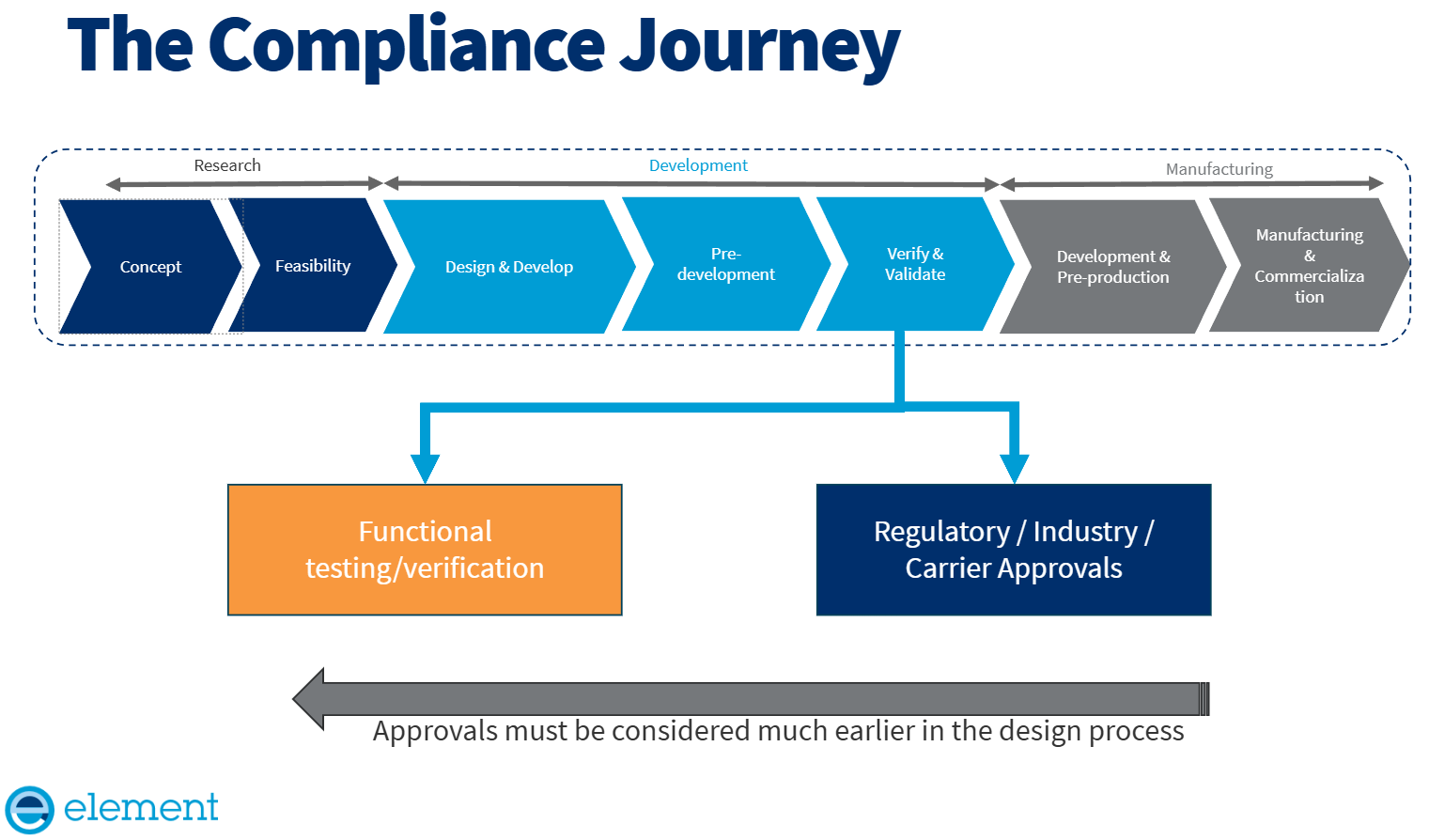
Requirements do not work that way. Standards contain construction requirements as well as test methods: a fuse must be fitted, a creepage distance maintained, a safeguard present. Radio technologies have to operate on frequencies and power levels permitted in your target markets, and those allocations differ between the FCC rules and the Radio Equipment Directive. None of it can be retrofitted to a finished device. A failed EMC scan can mean a new PCB layout, different shielding, or a component change — and each change invalidates evidence already generated, so the program pays for the same testing twice.
What verification and validation actually cover in product compliance
Verification asks whether the product has been built to its specification. Validation asks whether it performs safely and effectively where it will really be used. Both are broader than regulatory testing.
For the smartwatch:
- Is the heart rate, blood oxygen, and step measurement accurate enough to support the claim on the box?
- Does it work across the temperature, humidity, dust, and vibration it meets on a wrist, and survive distribution by road and air?
- Does it interoperate with the earbuds and phones its users own, is the battery safe, and does over-the-air performance hold up when the body blocks the signal?
Element’s experience across customer programs is that verification and validation absorb between 40 - 50% of the time and money spent bringing a connected product to market — too large a share to leave until the schedule is committed.
Product Compliance: The four tiers of approval a connected product may need
These layers are not interchangeable. A product can be fully compliant and still disappoint customers, or perform beautifully and remain illegal to sell.
Fit-for-purpose testing: the right to market the device
Functional and accuracy testing, environmental exposure, vibration and shock, battery life, reliability, packaging, and interoperability — the evidence that the product does what the datasheet claims.
Regulatory compliance: the right to sell the device
EMC and radio performance, product and battery safety, RF exposure, cybersecurity, restricted substances, and labelling. The route differs by market, so worldwide distribution needs a coordinated global market access plan rather than unconnected certification projects.
Industry certification: the purchasing requirement
Bluetooth, Wi-Fi, Matter, Zigbee, and Thread conformance programs are rarely a legal condition of sale but frequently a commercial one. Users look for the logo because it tells them the device will pair with what they own.
Carrier acceptance: permission to join the network
Cellular products may also need acceptance from a network operator, which controls what is allowed onto its spectrum. In North America, that typically means PTCRB certification plus carrier-specific requirements, and it often sits on the critical path.
When a lifestyle claim becomes a medical claim and how does that impact product compliance
Classification rests on the claims the manufacturer makes, not the sensors fitted. Once a device informs a health decision — flagging an irregular rhythm, predicting an ovulation window — it moves toward the medical device frameworks, clinical validation evidence, and IEC 60601-1-2 EMC requirements. Our whitepaper on wireless medical device compliance covers that boundary.
When should you test and certify in your product compliance programme?
Final certification testing needs a design and software build that represent what will be manufactured and sold. That does not mean waiting until then to do any compliance work.
Concept and feasibility
Define intended use and claims, the technologies involved, the target markets, and the applicable regulations and approval schemes. Conflicts surface cheaply here: a proposed radio technology or module may not be usable in every market on the forecast.
Design and development
Review schematics, layout, components, enclosure, and antenna integration against the relevant standards, then flow the same requirements to suppliers. Where a supplier offers a pre-approved radio module, check the scope of that approval closely — it supports an end-product program but does not complete it. Our whitepaper on the ETSI EN 300 220-2 V3.3.1 update shows how a standards revision can change what existing evidence covers.
Pre-compliance and de-risk testing
Some things cannot be assessed from datasheets. EMC is the standard example: individual parts may each have supporting data, but emissions and immunity behavior only becomes real once everything is assembled and running together. A prototype does not need to be certification-ready for an early scan to be useful — only representative enough to show whether the design is heading in the right direction. Our on-demand webinar on EMC pre-compliance offers practical insights for engineers.
Final compliance testing and certification
When compliance has been managed throughout, final testing becomes the last piece of the jigsaw — the step that generates the reports and certificates needed for market access.
Product compliance: How testing early protects profit
Steve makes the commercial argument with a cash flow curve. A program borrows money, spends it, and stays cash-negative until launch. Revenue then builds until end of life — and end of life is set by the market, not the manufacturer. However clever the product, a 3G design becomes obsolete when the network is switched off.
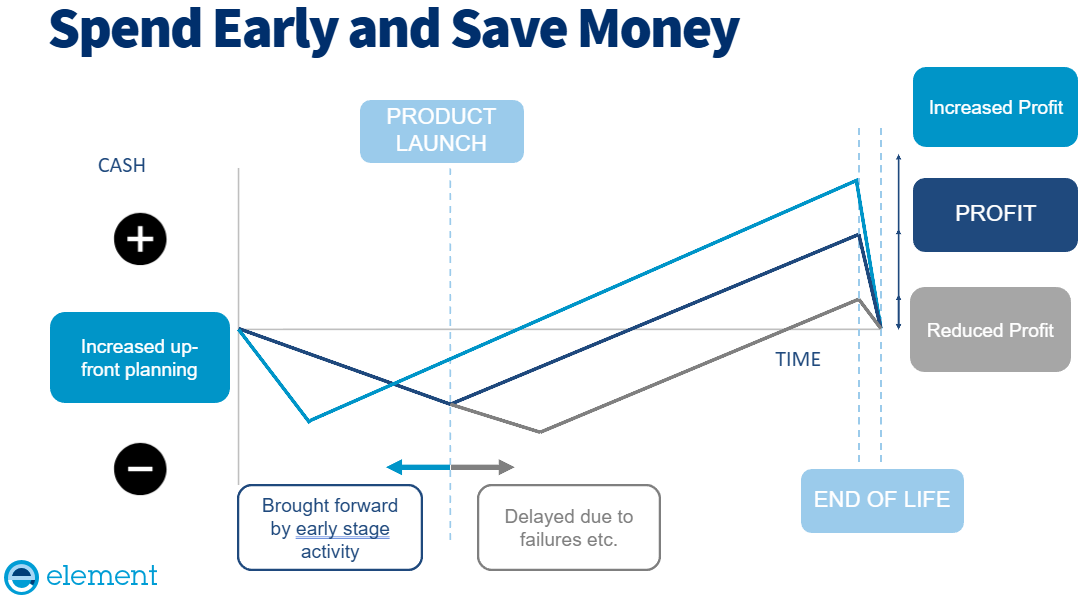
A late failure moves the launch to the right, and the recovery work is expensive on its own: root cause investigation, engineering changes, new prototypes, repeat testing, rescheduled production. The larger cost is time. Because the market absorbs product at its own rate, a delayed launch does not compress into a steeper revenue ramp — it removes months from the selling window, and those months are gone. Spending earlier reverses this, moving the launch date left and a larger commercial window for manufacturers.
Steve’s 4-step product compliance checklist to spend early and save money
- Plan verification and validation during design, not once the product is finished.
- Document a compliance strategy covering markets, regulations, standards, and approval schemes.
- Flow that strategy to the design team and the supply chain so everyone works to the same criteria.
- Identify milestones for de-risk testing on what suppliers cannot answer for you, EMC above all.
- Keep monitoring standards after launch — cybersecurity obligations that did not exist at design time are now mandatory.
Conclusion: make final certification the last step, not the first test
Early planning will not remove every technical problem, but it creates room to find risks and fix them before tooling, distribution agreements, and customer commitments are in place. The final test program then confirms what the team already expects rather than exposing something fundamental. Failing to plan, as Steve puts it, is a plan to fail — not for the product, but for getting it to market on time.
Element supports manufacturers with regulatory advisory work, test planning, pre-compliance evaluation, accredited wireless and EMC testing, certification and approvals, and global market access across 167 countries.
Speak to Element’s Connected Technologies team to discuss a compliance strategy or test program for your product and target markets.
Related Services

Connected Technologies
Accelerate your connected device certification with Element's comprehensive services. 17 global labs, 1,200+ experts, and end-to-end support for faster market access for mobile and and smart devices. Get certified today

Electromagnetic Compatibility (EMC) Testing & Electromagnetic Interference (EMI) Testing & Certification
Element provides accredited EMC and EMI testing and certification services, helping businesses meet regulatory requirements, reduce costly redesigns, and bring products to market faster through expert compliance support.

Wireless Device Testing & Certification
Get your wireless devices to market faster with Element's accredited testing services. Expert guidance through compliance, certification and global approvals for all wireless technologies.

Electrical Safety Testing and Certification Services
Accelerate your electrical product's journey to market with Element's comprehensive Electrical Safety Testing and Certification services. Navigate certification requirements efficiently, reducing time and costs while maintaining rigorous safety standards.

Battery Testing Services
Accelerate your product launch with Element's battery testing services. Superior safety, compliance, and performance data, custom protocols & real-time results. Learn More.

Electronic Product Certification and Approvals Services
Accelerate your electronic product certification with Element's ISO 17065-accredited services. Access 167 markets through one trusted partner. Expert testing & compliance support.