

Early Screening for Battery Safety: How In-Situ Gas Analysis Identifies Failure Chemistry Before Production

In-situ gas analysis measures battery gas generation from as low as 80 °C and attributes it to specific electrode reactions. Emily Klein, Element's Lead Failure Analysis Engineer, shows battery developers and safety engineers how flat-cell screening ranks chemistry candidates, and where that data stops being valid.
This whitepaper examines a lab-scale in-situ method that measures gas generation from as low as 80 °C, attributes it to specific electrode reactions, and states what that data can and cannot support.
Download the full whitepaper below.
Chemistry screening in early development is usually optimized for capacity and cycle life, with abuse behavior arriving later than is ideal when changing course costs most.
The key findings are:
- Accelerating rate calorimetry (ARC) gives reproducible onset and acceleration temperatures but no mechanistic resolution, it cannot separate anode-electrolyte interface reactions from SEI decomposition or cathode-side activity
- A three-electrode flat cell with an LFP reference electrode allows quantitative gas measurement and independent anode and cathode potential monitoring on one heating ramp
- It is a screening and mechanism tool: it ranks candidates by gas onset temperature and volume, but cannot predict vent volumes, pressure dynamics, or inter-cell propagation
What Standard Thermal Tools Can and Cannot Tell You
The role of accelerating rate calorimetry
ARC is the established approach for thermal onset characterization. Its heat-wait-seek protocol identifies self-heating onset temperature and the thermal runaway acceleration point with high reproducibility, producing kinetic parameters that feed propagation models and BMS thresholds. For setting a BMS limit, it remains the right instrument.
What it cannot provide is mechanistic resolution. It cannot separate an anode-electrolyte interface reaction from SEI decomposition or cathode-side activity, and reports nothing on which species evolve or from which component. For the mechanism itself, including how cathode chemistry sets the onset temperature, see Element's article on lithium-ion battery safety from cell chemistry to failure prevention.
The second constraint is timing. Most published gas analysis collects data after initial venting, by which point the cell has released a mixed inventory generated across a wide temperature range and no species can be tied back to the window or reaction that produced it. The measurement is real; the attribution is lost.
“ARC will tell you when a cell starts to self-heat and when it accelerates, and those numbers are reproducible enough to build a BMS threshold around. What it will not tell you is whether that early exotherm came from the anode-electrolyte interface, from SEI decomposition, or from the cathode side. And most published gas analysis samples after venting, by which point you cannot attribute anything to a temperature window.”
— Emily Klein, Lead Failure Analysis Engineer, Element
How Lab-Scale In-Situ Gas Analysis Works
The General Motors in-situ approach measures gas generated inside a lab-scale lithium-ion cell during controlled thermal abuse from as low as 80 °C, well before venting, using a modified flat cell in a three-electrode configuration with a lithium iron phosphate (LFP) thin-film reference electrode.
Two design decisions carry the method. Measuring gas inside a precycled cell preserves the electrolyte-electrode interface that cycling actually produced, rather than a pristine assembly no product will resemble in service. And the LFP reference electrode resolves anode and cathode potentials independently during heating, turning attribution from post-hoc inference into direct measurement: an event can be tied to the electrode whose potential moved with it. That separates early anode-driven gas generation from later cathode decomposition within a single ramp. The applications follow: comparing electrolyte formulations by gas onset temperature and volume, SOC-dependent profiling to inform charge limits, and fingerprint data to specify sensor requirements. Paired with XRD, SEM-EDS and XPS, it also supports mechanism attribution.
Where Each Test Method Belongs in the Development Process
A development program runs several testing regimes, each answering a specific question. Confusion arises when data generated for one answers another.
The paper sets out four stages:
- Stages 1 and 2, screening and mechanism. In situ flat-cell gas analysis, DSC, and ARC on small-format cells. These rank electrolyte and cathode candidates by gas onset temperature and volume, and attribute generation to electrode-level reactions. They cannot predict vent volumes, pressure dynamics, or inter-cell propagation.
- Stage 3, hazard characterization. Production-format ARC, nail penetration, oven testing, thermal propagation. These characterize vent gas volumes and pressure dynamics, assess propagation between cells, and evaluate vent path direction. They cannot attribute gas generation to specific electrode reactions or electrolyte components.
- Stage 4, regulatory certification. Full-format testing against applicable regional standards, demonstrating the production-format cell satisfies pass or fail criteria for the target market. It provides no mechanistic insight and cannot rank candidates.
One regulatory divergence bears directly on Stage 1 work. IEC 62619 and the Korean KC 62619 deviation call for hydrogen and hydrogen fluoride detection, and HF is not addressed in most US standards — so a program targeting Korea needs chemistry-level gas data a US-focused plan would never generate. The full standards matrix is tabulated in the full downloadable PDF; for transport requirements see Element's whitepaper on storage and shipping battery testing to UN 38.3.
These are complementary positions, not a hierarchy of rigor. Note the framework describes method placement, which test answers which question, a different axis from organizational safety maturity, covered in Element's webinar on Beyond Compliance battery safety webinar, and from the compliance sequencing covered in the full PDF.
Why Flat-Cell Data Has Known Boundaries
The flat cell uses single-layer electrodes, excess electrolyte, and a continuous gas-release pathway — precisely the choices that make real-time measurement possible, and the reason the data does not translate directly to production formats. In a sealed cell, pressure accumulates until venting, and the timing and character of that vent depend on format, housing rigidity, and safety valve design, none of which exist here.
Two boundaries are easy to overlook:
- Electrolyte-to-capacity ratio. Small lab cells typically run at 25 to 130 mL per Ah against below 10 mL per Ah in production cells, so consumption effects seen in a flooded lab cell may not appear in a lean production cell.
- Trigger mode. Thermally driven results are not predictive of electrically triggered failure such as overcharge or external short circuit, and cell impedance differs substantially between lab-scale and production formats.
These define the boundary of the method's validity, not flaws in its design.
Cell format compounds this: pouch cells rupture at variable seam locations with unpredictable vent direction, prismatic cells vent directionally but distribute heat by stack compression and tab placement, cylindrical cells vent predictably through burst discs. The PDF covers each geometry. The consequence is the same. Validate the screening result in the production-intent format, tested from cell to module to pack, before any production decision.
“A flat cell has single-layer electrodes, excess electrolyte and a continuous gas-release path. Those are the design choices that make real-time measurement possible, and they are also the reason you cannot read a vent pressure off it. It is a tool for ranking candidates and generating hypotheses. The production-intent format still has to answer the hazard questions.”
— Emily Klein, Lead Failure Analysis Engineer, Element
Interpreting Screening Results Without Over-Reading Them
A lower gas onset temperature, or higher gas volume in the early thermal regime, is a flag for investigation rather than a verdict. Three controls determine whether a comparison means anything.
- State of charge (SoC) comes first. The strong SoC dependence in the underlying study means small deviations in SoC or formation protocol shift onset temperatures enough to obscure chemistry-level ranking, so protocol standardization is not optional.
- Second, reproducibility must be confirmed per electrode batch and fill condition, and the degassing protocol affects results — the same consistency question addressed by battery cell validation.
- Third, a higher onset temperature in the higher-temperature regime is associated with a higher thermal runaway acceleration point in ARC, so parallel ARC runs test whether the two agree.
The larger question is external. No published study yet establishes whether a ranking of electrolyte formulations by gas fingerprint predicts the same ordering in production-format safety testing. If it holds even approximately, the method is a genuine early-stage filter; if not, that defines where the flat cell stops representing the real one. Until then, the defensible use is to eliminate clearly inferior candidates and generate hypotheses, then validate every advancing candidate in the production-intent format.
References and Supporting Documents
- Yadav, V., Wiebenga, M.H., Haddad, D., Salvador, J.R., Pieczonka, N.P.W., Schmidt, R.D., Gonzalez Malabet, H.J. and Wang, L. (2026). In situ analysis and mechanistic understanding of gas species generated in battery cells during thermal abuse. Journal of Energy Chemistry, 114, 699–708.
- Smith, A.J. et al. (2023). Potential and limitations of research battery cell types for electrochemical data acquisition. Batteries & Supercaps, 6(7), e202300080. — source of the electrolyte-to-capacity ratio comparison.
- Son, Y., Cha, H., Lee, T. et al. (2024). Analysis of differences in electrochemical performance between coin and pouch cells for lithium-ion battery applications. Energy & Environmental Materials, 7(3), e12615.
- Federal Aviation Administration, William J. Hughes Technical Center (2021). Evaluation of lithium battery thermal runaway propagation. DOT/FAA/TC-TN21/54.
- Feng, X. et al. (2018). Time sequence map for interpreting the thermal runaway mechanism of lithium-ion batteries with LiNixCoyMnzO2 cathode. Frontiers in Energy Research, 6, 126.
- Element Materials Technology (2025). Beyond Certification: What Our Global Abuse Labs Are Seeing Before Certification. Presentation.
Why download this whitepaper?
- Expert analysis of what ARC, DSC, and post-venting gas analysis can and cannot resolve.
- The full four-stage view of which test method answers which question, and where screening data stops being valid.
- The complete standards matrix with two worked compliance sequencing paths for lithium-ion EV cells.
- Format-specific failure behavior across pouch, prismatic, and cylindrical cells.
- Firsthand insight from Element's global abuse laboratories.
What this means for your development program
- Three points carry across the whole method.
- First, screening chemistry for failure behavior alongside capacity and longevity is a change of sequence, not of tooling — the instruments already exist.
- Second, the boundary is real and worth stating plainly: this is a mechanistically informative tool for early-stage triage, and its predictive validity for large-format behavior has not yet been demonstrated in the literature.
- Third, the controls matter more than the measurement, because without a standardized formation protocol and confirmed reproducibility per electrode batch, a chemistry-level ranking means nothing.
Element supports this work end to end, from chemistry screening and mechanism investigation through to production-format abuse testing and certification. Our battery testing laboratories cover battery safety and abuse testing, battery failure analysis, and lithium battery testing and certification. For a screening or abuse program built around your cell format and target markets, our teams can set out the route.
You can confirm Element's testing, inspection, and certification credentials on our About Element page.
If you are validating durability rather than abuse behavior, Element's whitepaper on combined temperature-vibration testing covers the mechanical side of early-stage test planning.
Download the full whitepaper as a PDF, to read offline or share with your team.
Frequently Asked Question
What is in-situ gas analysis in battery testing?
In-situ gas analysis measures gas species generated inside a lithium-ion cell in real time during controlled thermal abuse, rather than sampling after the cell has vented. A three-electrode flat cell with a lithium iron phosphate reference electrode allows measurement from around 80 °C while anode and cathode potentials are monitored independently, so gas events can be attributed to specific electrode reactions.
What are the limitations of accelerating rate calorimetry (ARC) for battery safety?
ARC identifies self-heating onset temperature and the thermal runaway acceleration point with high reproducibility, and yields kinetic parameters for propagation models and BMS thresholds. Its limitation is mechanistic: it cannot distinguish whether an early exotherm originates at the anode-electrolyte interface, from SEI decomposition, or from cathode-side reactions, and it reports nothing about which gas species evolve, at what temperature, or from which component.
Can coin cell or flat cell test data replace production-format battery testing?
No. Flat-cell and small-format data suit ranking chemistry candidates and investigating mechanism. They are not suited to vent gas volume prediction, vent timing and pressure transient characterization, propagation assessment between adjacent cells, or regulatory compliance demonstration. Lab-cell electrolyte-to-capacity ratios run at 25 to 130 mL per Ah against below 10 mL per Ah in production cells, and impedance differs substantially, so thermally driven results cannot be assumed to predict electrically triggered failure.
When should you use in-situ gas analysis instead of accelerating rate calorimetry?
Use both, at different stages. Run in-situ gas analysis when you need to know which electrode reaction drives early gas generation and to rank electrolyte or cathode candidates by gas onset temperature and volume. Use accelerating rate calorimetry when you need reproducible self-heating onset and acceleration temperatures to set a battery management system threshold. ARC tells you when a cell self-heats. In-situ gas analysis tells you why, and from which electrode.
Can flat-cell gas screening reliably rank electrolyte formulations for production?
Not on its own yet. Flat-cell screening ranks candidates by gas onset temperature and volume and flags weak formulations early, but no published study confirms that this ranking predicts production-format safety results. Treat it as an early filter. Eliminate clearly inferior candidates, then validate every advancing candidate in the production-intent format. Standardize state of charge and confirm reproducibility per electrode batch, or the ranking means nothing.
Emily Klein

Related Industries
Download
Early Screening for Battery Safety whitepaper
Related Services

Battery Testing Services
Accelerate your product launch with Element's battery testing services. Superior safety, compliance, and performance data, custom protocols & real-time results. Learn More.
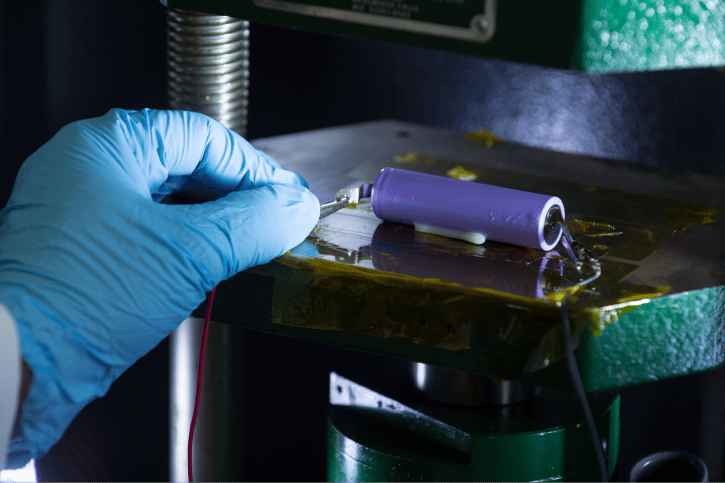
Battery Safety and Abuse Testing
Element delivers advanced battery safety and abuse testing for various chemistries and formats, helping identify risks, support certification, and meet global standards across diverse industries and applications.
Lithium Battery Testing and Certification Services
Ensure safety, performance, and regulatory compliance with comprehensive lithium battery testing. Element's advanced laboratories can test lithium metal and lithium-ion batteries for any application, from medical devices to electric vehicles.