

PFAS testing in water: key questions utilities are asking
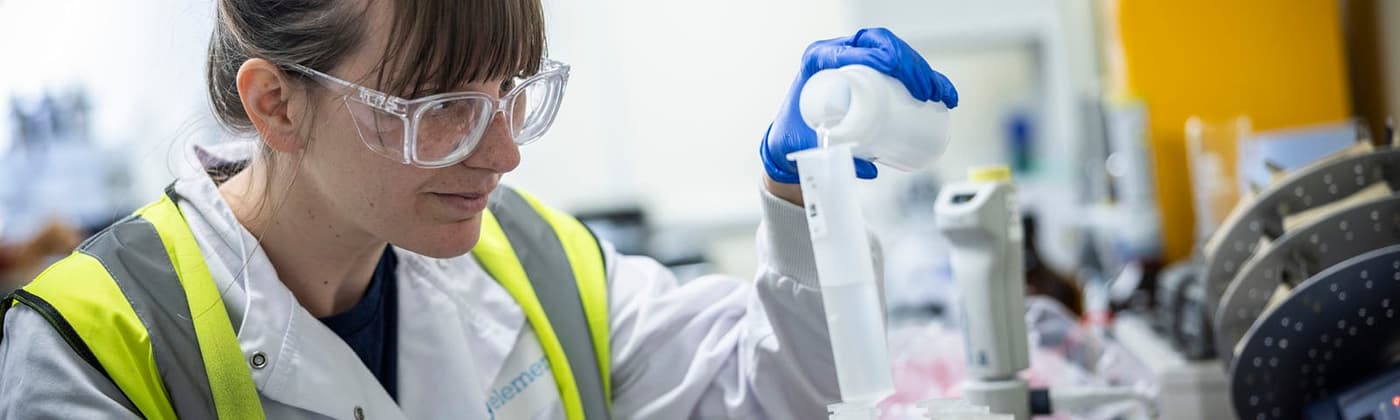
With increased focus on PFAS driven by a new government PFAS plan, forever chemicals are now firmly on the radar for water companies. Monitoring expectations are increasing, guidance is evolving, and testing programs are expanding. This Q&A with Marie Armstrong and Jenny Davies addresses the practical questions utilities are asking right now about sampling, accreditation and data quality.
For a broader introduction to PFAS substances, read our starter guide here: Answering your most Frequently Asked Questions
Why are PFAS such a concern for water companies?
PFAS are a group of man-made 'forever chemicals' that, once released into the environment, are highly resistant to degradation and have the potential to cause harmful effects on human health.
These chemicals move easily through water systems. PFAS has turned up in surface water, groundwater and drinking water sources, and UK monitoring has found it in around 80% of surface water samples and roughly half of groundwater samples tested [1].
Are water companies required to test for PFAS?
There's no single blanket limit applied across all water types. But water companies are expected to ensure drinking water is safe, which includes getting on top of substances that may pose a risk. PFAS sits squarely in that category.
Using AMP8 and DWI guidance to shape your approach is a smart way to prepare for tightening PFAS monitoring obligations. One way we see water companies do this is by making monitoring more routine. Their monitoring is often driven by risk assessments linked to source water and the activities happening in a given catchment area. This can include things like waste treatment plants, manufacturing sites and even the use of fire-fighting foam.
Evolving your monitoring program beyond a focus on simply identifying PFAS helps keep you ahead of the game. In our experience, proactive clients focus on understanding where PFAS may be present, how it could move through a catchment, and whether the data being generated is robust enough to support future decisions. You can develop this understanding for your program by paying greater attention to detection limits, sampling quality and contamination controls.
Below, we advise on what to prioritize for a flexible and proactive monitoring approach based on our experiences with clients.
How are AMP8 and DWI guidance changing PFAS monitoring approaches?
Water companies who want to respond most effectively to AMP8 and DWI guidance are doing a few things differently. Here’s how to start.
1. Take a closer look at where PFAS risks are most likely to sit within your networks and catchments.
DWI guidance has reinforced the need to understand potential sources of contamination, rather than treating every location in the same way. Source water, surrounding land use, and historic activities can all influence where monitoring takes place.
That includes areas close to industrial facilities, waste sites and locations where firefighting foams have been used historically.
2. Focus on long-term data collection to compare trends over time.
The challenge for utilities is not collecting a single set of results. It is building a monitoring program that delivers meaningful data year after year. Results need to stand up to comparison over time, particularly as monitoring expands and expectations continue to evolve.
3. Ask data quality questions early and keep approaches consistent
We're seeing more attention being given to the quality of the data itself. Questions around sampling methods, contamination controls and laboratory capability are becoming part of the conversation much earlier than they were a few years ago.
Those details matter. If different approaches are used across a program, it becomes harder to understand whether changes in results reflect what's happening in the environment or differences in how the samples were collected and analyzed.
Read on for our advice on avoiding inaccuracies with sampling.
What can go wrong during sampling?
Quite a lot, actually, and this is often where things go wrong.
PFAS is present in a huge range of everyday materials, which means contamination is a real risk if you're not on top of it.
You have to be careful with everyday items; things like waterproof clothing or packaging can introduce contamination without you realizing.
The basics matter:
• PFAS-free containers,
• no fluoropolymer materials,
• controlled sample handling,
• and field blanks run alongside every batch.
If something goes wrong at this stage, it travels with the sample all the way through to the result.
As reporting thresholds become lower, utilities should also pay close attention to sampling methodology and contamination controls. One of the biggest challenges is that, below a certain point, the issue is no longer instrument sensitivity; it's controlling background contamination well enough to trust the result.
A common misconception is that lower detection limits automatically mean better results. In practice, with instruments getting more sensitive, sample contamination often becomes the principal challenge.
Is PFAS testing done on site or in the lab?
For water, samples are taken at source and transported for laboratory analysis under controlled conditions; this keeps variability low and contamination risk manageable. Field techniques exist in some areas, but water testing has stayed firmly in the lab. That means the quality of the laboratory you're sending samples to matters enormously, and that's where accreditation comes in.
Why does accreditation matter so much?
Because it's more specific than most people assume.
You can't just be accredited for 'water'; each type has to be validated separately.
Groundwater, surface water and treated water can behave differently during analysis, and a lab needs to have validated its methods for each one individually. For utilities, that means checking the lab's accreditation actually covers the specific water type you're sending, not just the general category.
What happens once PFAS are detected?
Treatment is possible, but there's no simple fix. In water treatment, PFAS is typically captured using activated carbon filtration, and the captured material is then destroyed at very high temperatures.
That process creates its own monitoring requirements. Check emissions to confirm PFAS isn't being released somewhere else in the process, solving one problem while creating another isn't an option.
Where does this leave the industry?
PFAS has moved from a niche concern to a standard part of environmental monitoring and the pressure isn't easing.
Both the PFAS Plan and DWI guidance point towards greater scrutiny of monitoring data. Utilities are being asked not only to identify PFAS, but to understand what results mean and what action may be required.
Identifying PFAS is only part of the picture.
Interpreting the results, understanding the source of contamination and deciding what happens next are equally important.
Confidence in the quality of the data will become increasingly important.
Expectations are rising. The scrutiny is real, and the water industry needs to be ready.
[1] https://www.gov.uk/government/publications/pfas-plan/pfas-plan-building-a-safer-future-together
By Engaged Expert


Related Services
PFAS Testing Services
Element's ISO/IEC 17025-accredited PFAS testing delivers precise detection down to parts per trillion. With advanced instrumentation, dedicated laboratories, and expertise in regulatory compliance, we provide fast, reliable results across water, soil, and products. Our comprehensive solutions help you meet complex regulations while safeguarding human health and the environment.
Water Testing & Analysis Laboratory Services
Element’s accredited water testing provides fast reliable results, and contaminant detection to support compliance, risk mitigation, and all water types. Learn More.
Wastewater Testing Services
Element's state-of-the-art wastewater testing laboratories analyze your wastewater samples, deliver accurate results and provide the guidance you need to take the next steps.