

Compliance Test Data Reuse for Wireless Product Certification

Nima Molaei, Senior Global Technical Director at Element, sets out when compliance, certification, and engineering teams at wireless manufacturers can reuse existing test evidence after a product change. Across FCC, ISED, and CE/RED, reuse holds only when the evidence still represents the product and the correct route is chosen early.
A manufacturer may release a regional variant, remove a radio, update firmware, or integrate a certified module. Does that mean repeating the entire test program? Not always. The answer turns on three things: what changed, which regulatory route applies, and whether the existing compliance evidence still represents the product that will be placed on the market.
Reduced testing can take several forms. Depending on the project, the right route may be data reuse, a change in identification, multiple listings, a permissive change, FCC data referencing, ISED RF exposure data reuse, module integration, targeted retesting, or a new evaluation. These routes are not interchangeable. Some terms, including “data sharing,” are useful for industry shorthand rather than formal regulatory procedures.
The benefit is clear: manufacturers can reduce duplicate work and schedule pressure. But the existing compliance evidence must still be representative, traceable, and current; and it must be applied through the correct FCC, ISED, or CE/RED route.
Where should you start: the product change or the test report?
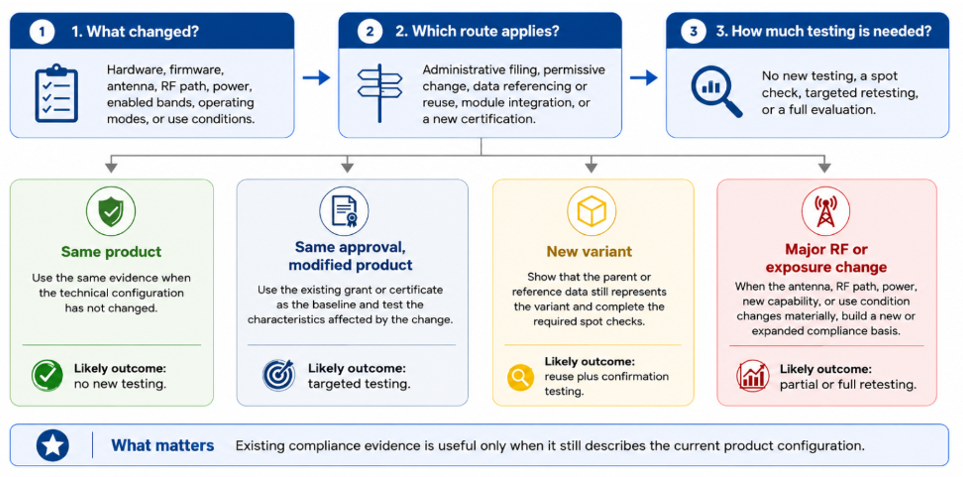
This process flow is the starting point. It helps project teams ask the right questions before deciding whether any testing can be reduced.
Teams often start by asking whether existing compliance evidence can be reused. A better first question is: what changed in the product? Once that is clear, the team can choose the appropriate filing or conformity assessment route and determine how much testing remains.
Most projects fit one of four situations:
- The product is technically identical;
- It has been modified under the same authorization;
- It is a new variant based on a parent or reference model; or
- It uses a certified module in a new host.
Once the change reaches the antenna, RF path, output power, enabled bands, software controls, or exposure conditions, a simple reuse approach may no longer be appropriate. Targeted or full retesting may be the more appropriate route.
How much Testing is Actually Needed?
Reduced testing is not a simple, yes-or-no decision. At one end, the existing compliance evidence already describes the current product configuration, and no additional testing may be needed. At the other end, the product may have changed enough that the reference reports no longer provide a reliable basis for compliance.
Between those two ends are spot checks and targeted retesting. A spot check makes sense when the reference data is expected to remain representative but needs confirmation. Targeted retesting should occur when the change affects only certain bands, modes, emissions, exposure conditions, or software-controlled features. The test plan should follow the change's technical impact, not simply the desire to test less.
What does a Spot Check actually prove?
Calling a spot check “mini compliance testing” misses the point. Its purpose is to show that a reference result still represents the current product configuration for a specific test method, band, operating mode, exposure condition, or simultaneous-transmission case.
A product can pass the regulatory limit and still fail the reuse rationale. If the spot-check result differs significantly from the parent or reference result, the reference data may no longer accurately reflect the current product configuration. The right response is to test that condition fully or widen the evaluation, not to force the data into a reuse path.
Good documentation makes the relationship clear. It should show that the reference report still covers the current product configuration, link any supplemental or variant-specific evidence to the documented model differences, and confirm that the report, standard version, and test method remain acceptable in the target market. The file should clearly distinguish between the reference evidence, any supplemental or variant-specific evidence, and the resulting compliance basis.
How do FCC, ISED, and CE/RED treat data reuse differently?
FCC, ISED, and CE/RED can all use existing compliance evidence, but the legal and procedural routes differ. The comparison below provides the context for the market-specific sections that follow.
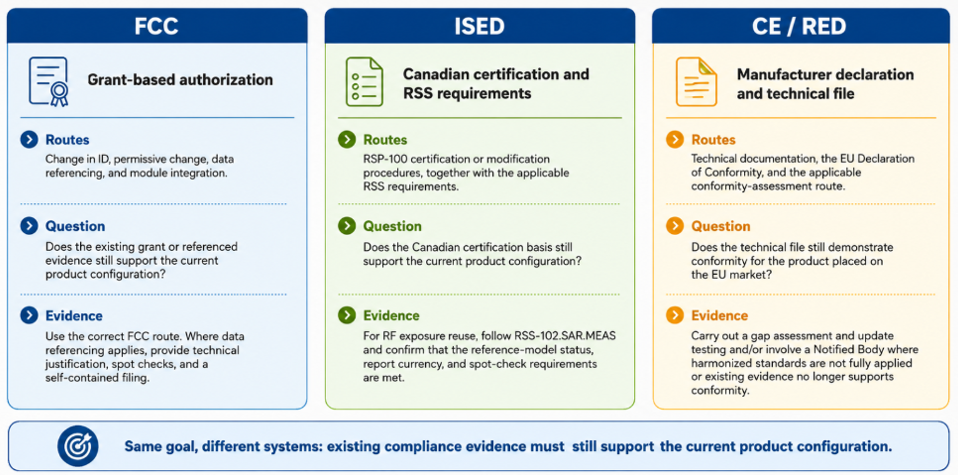
The same product change can therefore lead to a different filing, certification, or conformity-assessment route for each market.
FCC: which authorization route fits your change?
Under the FCC equipment authorization rules, the authorization route comes first. Depending on the product relationship and the scope of the change, the appropriate path may be a change in identification, permissive change, data referencing, module integration, or a new certification.
Under 47 CFR Section 2.933, changing the FCC Identifier requires a new application. The abbreviated procedure may rely on the original test data only if the design, circuitry, and construction have not changed and the applicant confirms that the original results still apply. If the technical changes fall outside the permissive-change rules, a complete application is required.
Permissive changes are covered by 47 CFR Section 2.1043. A Class I change does not degrade the reported characteristics and does not require an FCC filing. A Class II change worsens one or more reported characteristics but still meets the rules; the affected test results must be filed, and the modified equipment cannot be marketed under the existing grant until the change is acknowledged. Class III applies only to software-defined radio transmitters and also requires supporting results and acknowledgement before the modified software is loaded or marketed.
FCC data referencing is a separate route. KDB 484596 D01 v03 permits test data from a previously submitted related application under the same grantee code to support a variant when the parent data still represents that variant. The variant application must stand on its own. It should include the referenced parent data, a clear description of the differences, the required spot checks, and a technical explanation of why the reference results still apply. More about managing changes and variants and their associated compliance can be found in our on-demand webinar here.
FCC KDB 996369 provides the module-integration framework. A host manufacturer may rely on module evidence when the integration remains within the module grant conditions, but the host is still responsible for antenna implementation, co-location, RF exposure, labelling, user information, and non-module circuitry.
Where a product change falls outside the limits of the existing authorization, cannot be supported through a permissive change, or is no longer adequately represented by existing compliance evidence, a new equipment authorization may be required. In that case, the test program should establish a new compliance basis for the affected transmitter functions and operating conditions rather than trying to extend the previous grant beyond its scope.
For FCC:
Choose the authorization route first. Changes in ID, permissive changes, data referencing, module integration, and new certification can all require or use different evidence packages; the filing and supporting documentation differ for each route.
ISED: how do Canada's certification and RF exposure rules differ?
For Canada, the project must be assessed under ISED procedures and the applicable Radio Standards Specifications. The same test campaign can often support both U.S. and Canadian filings, but an FCC conclusion does not automatically carry over to ISED. The Canadian reports, certification application, and RF exposure assessment must meet the Canadian requirements.
ISED RSP-100, Issue 12, covers certification procedures, family certification, multiple listings, and product modifications. It distinguishes C1PC for changes that do not affect fundamental RF characteristics, C2PC for permitted hardware changes, C3PC for RF-affecting firmware changes, and C4PC for changes that affect module integration and therefore the originally reported RF emissions or RF exposure assessment. Each application must assess the product against the latest applicable standards and determine whether additional testing is required.
RF exposure reuse is one of the clearest differences between the two countries. RSS-102.SAR.MEAS, Issue 2, does not accept FCC KDB 484596 D01 as the Canadian procedure. It sets its own eligibility and confirmation-testing requirements, including conducted-power comparisons, SAR or APD spot checks where applicable, simultaneous-transmission assessment, and criteria that can trigger additional testing.
RSS-Gen, Issue 5, including its amendments, also covers module and host labelling. If the module label is not visible after installation, the host must show “Contains IC:” followed by the module certification number. This labelling requirement is separate from the technical decision on whether the RF data can be reused.
For ISED:
Do not carry an FCC conclusion directly into the ISED file. Confirm the Canadian certification route, current RSS requirements, the eligibility and currency of the referenced reports, RF exposure reuse conditions, and module-host labelling.
Why does RF exposure need a separate assessment?
The same product change can affect EMC and RF exposure in different ways, so the two conclusions should be kept separate. A change may have little effect on the results of conducted radio measurements but still alter near-field exposure. Another change may affect spurious emissions without materially changing SAR or power density. Each requirement should be reviewed for transmitter, band, operating mode, use condition, and simultaneous- transmission combination.
Across the certification projects we support, one pattern recurs: a product change can leave EMC and transmitter-emissions results comfortably within limits while still affecting RF exposure. This often happens when the antenna position, surrounding materials, or separation from the user changes, or when firmware modifies output power, duty cycle, antenna switching, or exposure time-averaging. Those changes can alter local field distribution or maximum time-averaged transmit power, meaning the SAR or power-density margin may move even when the emissions profile barely changes. For data reuse, passing EMC or RF emissions testing is not enough; the RF-exposure impact must be assessed separately.
RF exposure is particularly sensitive to antenna location, device structure, grounding, enclosure materials, power control, time averaging, separation distance, and simultaneous transmission. Removing a component near an antenna, for example, can change the near field even when conducted power stays the same. A firmware change to power control may also affect the RF exposure assessment while leaving many other RF results unchanged.
A feature list alone is not enough. A radio may be removed, disabled, or regionally locked, but the effect on emissions and exposure still depends on the product design and how the change was implemented.
Does a certified module make your host product compliant?
A certified module is a useful starting point, but it does not automatically make the host product compliant. The module grant or certificate sets out the conditions of use. When the host follows those conditions, the manufacturer may rely on the module data for the covered transmitter characteristics. When it does not, additional evaluation may be needed.
The host review should cover antenna type and gain, antenna location, separation distance, co-location with other transmitters, enclosure and grounding effects, RF exposure, user information, and labelling. The host’s digital circuitry, power supply, and any other transmitters may also need separate evaluation. In Canada, integration that changes the module’s originally reported RF emissions or RF exposure assessment is handled under C4PC and requires the Host Marketing Name (HMN), along with the module labelling required by RSS-Gen.
Modular approval can reduce testing, but the host manufacturer still owns the final configuration. A clear integration package shows what the module approval covers, and what has been checked at the host level.
More information about integrating radio modules can be found in our guide here.
CE/RED: does your technical file still cover the product?
CE marking under the EU Radio Equipment Directive works differently from FCC or ISED certification. There is no product grant. The manufacturer is responsible for meeting the applicable essential requirements, preparing the technical documentation, issuing the EU Declaration of Conformity, and affixing the CE mark before the product is placed on the EU market.
Existing reports can support the technical file only when they still cover the current product configuration being placed on the market. The manufacturer should compare the reference configuration with the current product configuration, identify the essential requirements affected by the change, check the applicable harmonized standards and any OJEU restrictions, and confirm that the existing compliance evidence remains current and representative. Any gaps require supplemental testing or reassessment. More detail regarding harmonized standards with restrictions can be found here.
Under RED Article 17, a notified-body route is required for Article 3(2), and any applicable Article 3(3) requirements when harmonized standards have not been applied, have been applied only in part, or do not exist. The manufacturer must then use either EU-type examination followed by conformity to type, or the full quality-assurance route. Product changes therefore need to be assessed against both the technical file and the selected conformity-assessment route.
Cybersecurity is now part of the reuse decision for many connected products. The RED Article 3(3)(d), (e), and (f) requirements have applied to relevant radio equipment since 1 August 2025. EN 18031-1:2024, EN 18031-2:2024, and EN 18031-3:2024 are listed as harmonized standards with restrictions. Changes to firmware, connectivity, cloud services, privacy controls, credentials, or update mechanisms may therefore require a fresh gap assessment even when the RF test data is unchanged. Manufacturers should also plan for the next transition: Delegated Regulation (EU) 2022/30 will be repealed with effect starting 11 December 2027 as the Cyber Resilience Act becomes fully applicable.
For CE/RED:
Treat reuse as a technical file decision. The manufacturer must demonstrate that the existing compliance evidence continues to support the essential requirements for the product placed on the EU market.
How should you plan a data reuse strategy?
Make the data reuse decision before the project schedule assumes a reduced test program. Start with a clear description of the product differences. Then choose the regulatory route, identify the requirements affected by the change, and set a test plan that determines and explains why no testing, spot checks, targeted testing, or a full evaluation is appropriate.
The review is much easier when the basic information is ready: the relationship between the models, the reference grant or certificate, a hardware and software change summary, antenna and RF-path comparisons, supported bands and modes, power information, simultaneous-transmission conditions, intended use and separation distance, and the report and standard versions being relied upon.
Strong configuration control makes reuse much easier to justify. Product teams should preserve the common RF architecture where possible, document firmware controls, clearly map model differences, and keep test evidence up to date. When the change record is incomplete, reviewers may need to request more testing because the link between the reference configuration and the current product configuration cannot be clearly demonstrated.
How Element can Help
Element can review product changes before testing begins, help define a proportionate test plan, and prepare the supporting FCC, ISED, and CE/RED evidence. Early review can reduce unnecessary testing and help avoid certification gaps late in the program.
Frequently Asked Questions
Can you reuse existing test data when you modify a wireless product?
Sometimes. Whether existing test data can be reused depends on what changed, which regulatory route applies, and whether the evidence still represents the product placed on the market. Minor changes may need no testing or a spot check, while changes to the antenna, RF path, output power, enabled bands, or RF exposure often require targeted or full retesting.
Does an FCC certification cover Canada?
No. FCC certification is not accepted in Canada, and ISED certification is not accepted in the United States, so separate certifications are required. One test campaign can often support both filings when the standards align, but the Canadian reports, application, and RF exposure assessment must meet ISED requirements.
What is the difference between a Class I and a Class II permissive change?
A Class I change does not degrade any reported characteristic and needs no FCC filing. A Class II change worsens one or more reported characteristics while still meeting the rules, so you must file the affected test results, and you cannot market the modified device under the existing grant until the FCC acknowledges the change.
Do you need to retest a product that uses a certified radio module?
Not always. If the host follows the module grant conditions and installation instructions, you may rely on the module data for the covered transmitter characteristics. The host still owns antenna implementation, RF exposure, co-location, labeling, and any non-module circuitry, which can trigger additional evaluation.
Reusing compliance evidence can shorten schedules, but the decision should be made at the start of the project, before the test plan is locked. The central question is whether the existing compliance evidence still reflects the current product configuration, operating conditions, and applicable rules.
Each market reaches that answer differently. FCC uses routes such as change in identification, permissive change, data referencing, module integration, or a new certification where the existing authorization no longer applies. ISED applies Canadian certification procedures and its own RF exposure reuse rules. CE/RED relies on the manufacturer’s technical file and the conformity assessment route.
Across all three markets, the practical sequence remains consistent:
- Define the change,
- Choose the appropriate regulatory route,
- Test what needs confirmation, and
- Document why the reference evidence remains applicable.
That turns data reuse into a planned compliance strategy rather than a late-stage request to reduce testing.
References and Source Notes
[1] FCC OET Knowledge Database, KDB 484596 D01, Referencing Test Data, v03, March 21, 2025.
https://apps.fcc.gov/oetcf/kdb/forms/FTSSearchResultPage.cfm?id=219679&switch=P
[2] FCC OET Knowledge Database, KDB 996369 series, including D04 Module Integration Guide, v02, November 15, 2024.
https://apps.fcc.gov/oetcf/kdb/forms/FTSSearchResultPage.cfm?switch=P&id=44637
[3] 47 CFR Section 2.933, Change in Identification of Equipment, Title 47, Chapter I, Part 2, Subpart J, Electronic Code of Federal Regulations. (eCFR). https://www.ecfr.gov/current/title-47/chapter-I/subchapter-A/part-2/subpart-J/section-2.933
[4] 47 CFR Section 2.1043, Changes in Certificated Equipment, Title 47, Chapter I, Part 2, Subpart J, Federal Communications Equipment Authorization Procedures. https://www.ecfr.gov/current/title-47/chapter-I/subchapter-A/part-2/subpart-J/section-2.1043
[5] ISED RSP-100, Issue 12, Certification of Radio Apparatus and Broadcasting Equipment, August 2019.
[6] ISED RSS-Gen, General Requirements for Compliance of Radio Apparatus, Issue 5 (April 2018), Amendment 1 (March 2019), Amendment 2 (February 2021).
[7] ISED RSS-102.SAR.MEAS, Measurement Procedure for Assessing Specific Absorption Rate (SAR) Compliance in Accordance with RSS-102, Issue 2, August 15, 2025 (page modified October 24, 2025).
[8] Directive 2014/53/EU, Radio Equipment Directive, consolidated version current as of 30 May 2026, particularly Article 17 and Annexes II-IV.
https://eur-lex.europa.eu/eli/dir/2014/53/oj/eng
[9] Commission Implementing Decision (EU) 2025/138 of 28 January 2025 amending Implementing Decision (EU) 2022/2191.
https://eur-lex.europa.eu/eli/dec_impl/2025/138/oj/eng
[10] Commission Delegated Regulation (EU) 2022/30 of 29 October 2021 supplementing Directive 2014/53/EU.
https://eur-lex.europa.eu/eli/reg_del/2022/30/oj/eng
[11] Commission Delegated Regulation (EU) 2026/339 of 16 February 2026 repealing Delegated Regulation (EU) 2022/30, Official Journal of the European Union, OJ L 2026/339, 29 April 2026.
https://data.europa.eu/eli/reg_del/2026/339/oj
[12] Regulation (EU) 2024/2847 of the European Parliament and of the Council of 23 October 2024 on horizontal cybersecurity requirements for products with digital elements (Cyber Resilience Act), fully applicable from 11 December 2027.
By Engaged Expert



Related Services

FCC Certification and Testing for the U.S. Market
Get FCC certification for wireless devices from Element, an authorized TCB and CAB (FCC testing center). One accredited lab does it all – test, document, certify.

ISED Certification for Canada
Get ISED certification faster with Element's end-to-end testing and certification services, documentation support, and FCB authorization for seamless Canadian market access.

RED Directive Testing for CE Marking
Element's Radio Equipment Directive (RED) services provide testing, certification, and expert guidance to help manufacturers meet EU compliance requirements and secure CE marking for wireless products.